
Plant Encyclopedia

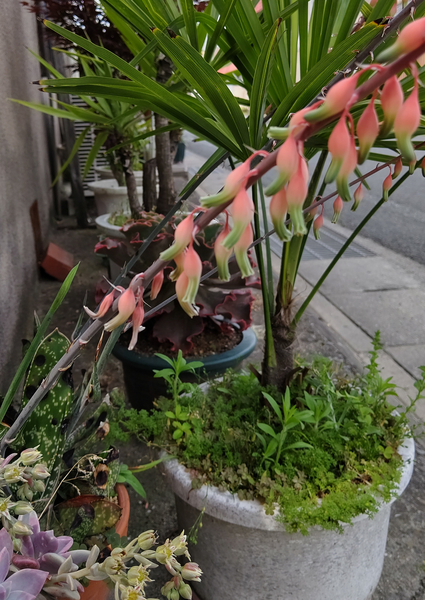
Gasteria (genus)
Japanese name: ガステリア
Scientific name: Gasteria
[Overview]
A perennial cultivated as an ornamental succulent.
The leaves are fleshy; sword-shaped to tongue-shaped leaves are borne alternately, or slender leaves form a rosette.
Leaf shape and color vary with the type, and many have pale green to white markings.
A raceme or panicle is borne at the end of a long flower stalk extending from the leaf axils, and many flowers bloom hanging downward.
The corolla is tubular with a rounded, swollen base, and the tip opens slightly or stays closed.
The flowers are green at the tip and salmon-orange to deep pink below; the green part turns yellow or pale as the flower opens.
[Cultivation]
Propagate from seed, by division, or by leaf cuttings.
It prefers partial shade and well-drained soil, and potting mix for cacti is suitable.
If the light is too poor, the leaves become long and thin and may lose their natural form.
Turn the pot from time to time so that the leaves do not lean to one side.
During long rainy spells, keep it in a well-ventilated place out of the rain, such as under the eaves or on a veranda.
In winter, bring it indoors to a sunny place.
In spring and autumn, water once every 2 weeks to 1 month, when the soil has dried, until water runs out of the bottom of the pot; in midsummer and winter, almost stop watering.
Poor ventilation or excess moisture causes root rot.
For fertilizer, a small amount of slow-release fertilizer at repotting is enough.
Pests and diseases include soft rot and scale insects.
[Notes]
The scientific name comes from the flower's resemblance in shape to a stomach (gaster).
Details
Translated from our Japanese encyclopedia. If anything differs, the Japanese page is correct.