
Plant Encyclopedia

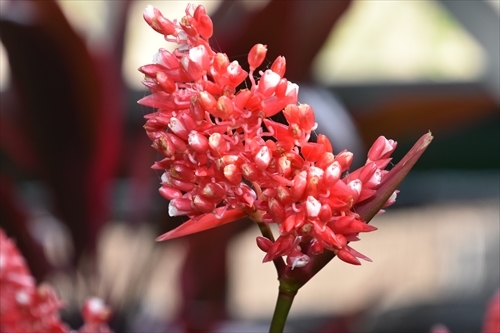
Stromanthe sanguinea (stromanthe, "Urabenisho")
Japanese name: ウラベニショウ (裏紅蕉)
Scientific name: Stromanthe sanguinea
[Overview]
An evergreen perennial distributed in the tropical rainforests of Brazil, 1–1.5 m tall and 0.9 m wide.
It has rhizomes and an erect stem.
The leaves are simple and basal in two rows, lanceolate to elliptic, up to 50 cm long and 15 cm wide, with entire margins, leathery, and glossy on the upper surface.
The upper surface is dark green with a pale green midrib, and the underside is reddish purple.
At night the leaves stand upright and close, and the red undersides become conspicuous.
A panicle 5–7.5 cm long at the tip of the flower stalk bears conspicuous red bracts.
The flowers emerge from between the bracts but are small, about 1 cm long, with a white corolla and orange-red sepals.
The fruit is a capsule.
[History]
It was introduced to Japan in the early Showa era.
[Cultivation]
Propagate by division or by stem cuttings (cuttings of offsets).
To overwinter, keep it at 6–7°C or above.
It prefers bright shade and fertile, well-drained soil.
If the light is too poor, the leaf color of variegated cultivars becomes poor.
Strong direct sunlight in summer causes leaf scorch or curling of the leaves.
From spring to autumn, water thoroughly when the soil surface dries; keep it on the dry side in winter, but do not let it dry out completely.
It prefers an environment with high air humidity, so mist the leaves frequently.
From spring to autumn, apply slow-release fertilizer once every 2 months.
Pests and diseases include black spot, leaf spot, scale insects and spider mites.
Details
Japanese: ウラベニショウ(裏紅蕉)
Translated from our Japanese encyclopedia. If anything differs, the Japanese page is correct.