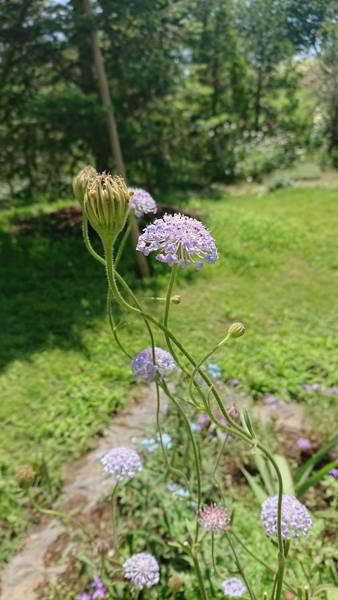
Japanese name: ブルーレースフラワー Scientific name:Trachymene coerulea
[Overview]
An annual 0.5–1 m tall.
It branches, and the stems and leaves have fine hairs.
The leaves are alternate, deeply 3-lobed, with the lobes divided further.
At the tips of long flower stalks, hemispherical umbels about 5–7 cm across bear many small blue flowers densely.
[Cultivation]
Propagate from seed.
The optimum germination temperature is around 20°C; sow in autumn in warm regions and in early spring in cold regions. It has a taproot and dislikes transplanting, so sow in plastic pots before planting out, and in regions with frost, protect it from frost.
It prefers a sunny, well-drained place, suits cool regions, and dislikes heat, humidity and acidic soil.
Take care not to let it become too wet when watering; for potted plants, water thoroughly when the soil surface dries, and for plants in the ground, rainfall is sufficient. During long rainy spells, move potted plants to a place out of the rain.
Overfeeding makes it leggy and prone to falling over, so fertilize sparingly; apply fertilizer at planting and give liquid fertilizer as appropriate.
The plant grows tall, so set up stakes.
Aphids can occur.