
Plant Encyclopedia

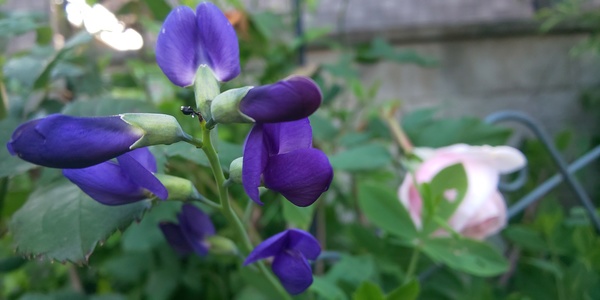
Baptisia australis (blue wild indigo, "Murasakisendaihagi")
Japanese name: ムラサキセンダイハギ (紫先代萩)
Scientific name: Baptisia australis
[Overview]
A perennial 1–1.5 m tall.
The stem is erect and branched, hairless, and slightly glaucous together with the leaves.
The leaves are alternate and trifoliate; the leaflets are oblanceolate to obovate, 1.8–3.8 cm long.
The stipules are linear-lanceolate and attached at the base of the leaf stalk.
Racemes about 30 cm long emerge at the stem tips and leaf axils, bearing blue to purple pea-shaped flowers.
The bracts are linear-lanceolate.
The fruit is an oblong pod 2.5–7.5 cm long containing many seeds, and turns black when ripe.
[Uses]
Shaking a branch with ripe pods makes a rattling sound, and children are said to have played with it as a rattle.
The stems with pods are also used as dried flowers.
Native Americans used it medicinally and as a blue dye.
[Cultivation]
Propagate from seed or by division.
It prefers a sunny, well-drained site and is easy to grow.
For potted plants, water thoroughly when the soil surface dries; for plants in the ground, rainfall is sufficient unless sunny weather continues and the soil dries out.
Fertilize sparingly; if a base fertilizer is applied, none is particularly needed, but for potted plants, while watching their condition, place a small amount of slow-release fertilizer on the soil in spring or autumn.
There are no particular pests or diseases.
Details
Japanese: ムラサキセンダイハギ(紫先代萩)、バプティシア
Translated from our Japanese encyclopedia. If anything differs, the Japanese page is correct.