
Plant Encyclopedia

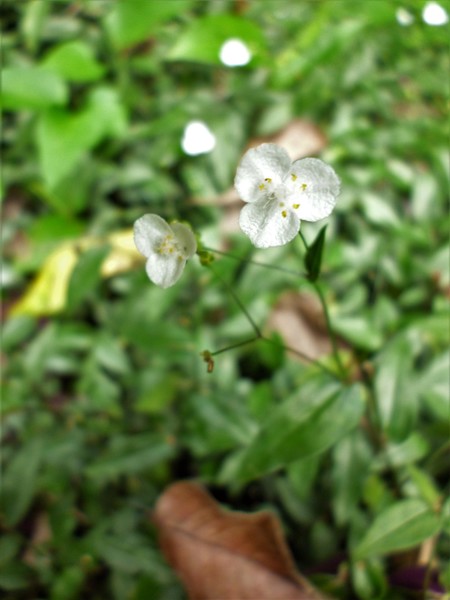
Gibasis pellucida (Tahitian bridal veil)
Japanese name: ブライダルベール
Scientific name: Gibasis pellucida
[Overview]
An evergreen perennial 10–20 cm tall.
The stems are thin and purplish, creeping along the ground and extending long, rooting at the nodes as they spread.
The leaves are simple and spirally alternate, ovate-lanceolate to lanceolate-oblong, 2.5–7 cm long and 1.5–2.5 cm wide; the surface is glossy, both sides are hairy, the base clasps the stem, and the margin is entire.
In the cultivated strain the leaves reach only about 2.5–3 cm long, are almost hairless except at the base, and are deep reddish purple on the underside.
It flowers all year round if the temperature is sufficient.
Sparsely branched cymes emerge from the stem tips and leaf axils.
The flowers are white, three-petaled, and about 0.6 cm across.
There are 6 stamens, and the filaments have white hairs.
The fruit is a capsule.
[Cultivation]
Propagate by division or stem-tip cuttings.
It needs only about 5°C to overwinter, so move it to a sunny place indoors in winter.
It prefers fertile soil in a sunny, well-drained, well-ventilated place, but strong direct sun in summer can scorch the leaves, so keep it in bright partial shade in summer.
From spring to autumn, take care not to let it dry out, and water thoroughly when the soil surface begins to dry.
In winter it is best kept slightly on the dry side; water after the soil has dried.
From spring to autumn, apply slow-release fertilizer placed on the soil.
Pests and diseases include anthracnose, spider mites and scale insects.
Details
Japanese: ブライダルベール、ヒメトキワツユクサ(姫常盤露草)、シダレツユクサ(枝垂露草)
Translated from our Japanese encyclopedia. If anything differs, the Japanese page is correct.