
Plant Encyclopedia

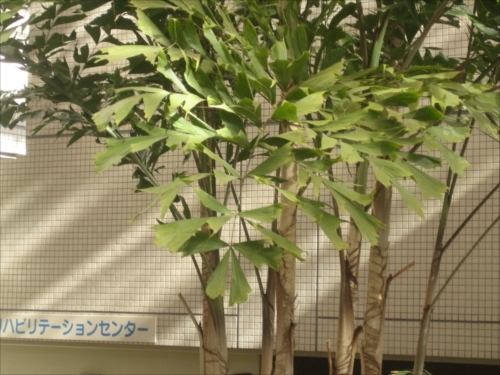
Caryota mitis (clustering fishtail palm, "Komochikujakuyashi")
Japanese name: コモチクジャクヤシ (子持孔雀椰子)
Scientific name: Caryota mitis
[Overview]
A palm growing to about 10 m tall.
It produces many trunks and forms a clump.
The trunks are cylindrical, 8–20 cm across, with ring-shaped scars where leaves have fallen, so they look like bamboo.
There are no spines.
The leaves are alternate on the upper part of the trunk and bipinnately compound, about 1.5–3 m long including the petiole.
The leaflets are 10–18 cm long, broadly wedge-shaped like a fish's tail fin, with the upper edge irregularly notched.
Flowers bloom when the trunk has finished growing and the life of the plant is ending; the first inflorescence appears at the top of the trunk, followed in turn by inflorescences below it, which flower and fruit progressively downward, and after several rounds of flowering the trunk dies.
There are male and female flowers, borne densely in large numbers on spadices 0.3–0.6 m long emerging from among the leaves.
Male flowers are about 1 cm long with 12–24 stamens; female flowers are smaller than male flowers.
The fruit is spherical, up to 2 cm across, ripening blackish purple and sometimes tinged with red.
[Cultivation]
Propagate from seed.
It can be grown outdoors in Okinawa, but for overwintering place it in a bright spot indoors in winter so that it stays at 10°C or higher.
It prefers full sun to bright shade and fertile, well-drained soil.
For potted plants, water thoroughly when the soil surface dries from spring to autumn, and keep it on the dry side in winter.
For plants in the ground, rainfall is sufficient.
From spring to autumn, place slow-release fertilizer on the soil once every 2 months.
Pests and diseases include scale insects, spider mites and Perostachia disease.
Details
Japanese: コモチクジャクヤシ(子持孔雀椰子)、カブダチクジャクヤシ(株立孔雀椰子)
Translated from our Japanese encyclopedia. If anything differs, the Japanese page is correct.