
Plant Encyclopedia

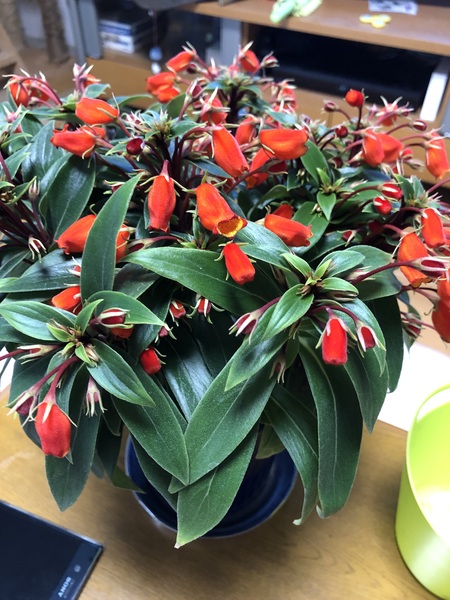
Gloxinia (genus)
Japanese name: シーマニア
Scientific name: Gloxinia
[Overview]
Gloxinia sylvatica and G. nematanthodes, among others, are sold under this name.
A perennial.
It has underground stems.
The leaves are simple and opposite, lanceolate to oblong.
The flowers are borne at the ends of flower stalks arising from the axils of the upper leaves or bracts on the stem.
The corolla is red to orange, bell-shaped to slender urn-shaped, with a short 5-lobed tip.
[Cultivation]
Propagate by division, suckers, or shoot cuttings.
When dividing, divide so that each clump has at least 3 buds.
It prefers soil that is well drained and well aerated.
In spring and autumn place it in a sunny spot, and in midsummer keep it cool in bright shade.
For overwintering, keep it at 10–15 °C or higher, in a warm, sunny place indoors.
Water so that it never dries out, while taking care not to overwater; from spring to autumn, water thoroughly when the soil surface dries.
In winter, water the same way if it can be kept at 15 °C or higher, but if the temperature falls below 15 °C, keep it on the dry side.
Apply slow-release chemical fertilizer as basal fertilizer, and from spring to autumn also apply liquid fertilizer once every 2 weeks or slow-release chemical fertilizer once a month.
Remove spent flowers and dead leaves promptly.
Pests and diseases include gray mold and cyclamen mites (broad mites).
[Notes]
It is called by this name because it was formerly classified in the genus Seemannia.
Details
Translated from our Japanese encyclopedia. If anything differs, the Japanese page is correct.