
Plant Encyclopedia

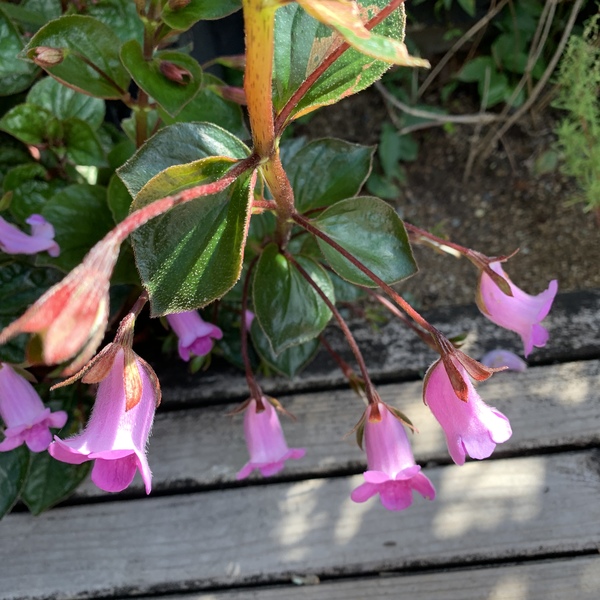
Sinningia (genus, "Gurokishinia")
Japanese name: グロキシニア
Scientific name: Sinningia
[Overview]
It was created by crossing several species, centered on Sinningia speciosa (Oo-iwagirisou).
A perennial.
It has tubers.
The leaves are simple, basal or opposite, obovate to oblong, thick, and succulent.
Both sides of the leaves are densely covered with fine, soft hairs, giving a velvety texture.
The leaf margins have fine, rounded serrations.
The flowers are borne singly at the tips of flower stalks emerging from the leaf axils, and the flower colors and shapes are varied.
[History]
It is said to have arrived in Japan in the early Meiji era.
[Cultivation]
Propagate from seed or by leaf cuttings.
The seeds need light to germinate and are very fine, so do not cover them with soil.
The optimum germination temperature is relatively high at 25 degrees, and the optimum growth temperature is 20–25 degrees.
It prefers soil that is well drained, airy, and moisture-retentive.
It dislikes heat and humidity and can suffer leaf scorch in strong sunlight, so grow it in bright shade indoors throughout the year, keeping it especially cool in summer.
To be safe, keep it at 10 degrees or above for overwintering.
From spring to autumn, when the soil surface dries, water thoroughly from the edge of the pot so as not to wet the leaves or flowers, or water from the bottom; when the above-ground parts begin to die back, gradually reduce watering, and stop watering in winter.
Apply slow-release fertilizer as a base fertilizer, and also apply liquid fertilizer once every 2 weeks during the flowering period.
Remove spent flowers promptly.
Gray mold can occur.
[Notes]
It is called by this name because it was formerly classified in the genus Gloxinia.
Details
Translated from our Japanese encyclopedia. If anything differs, the Japanese page is correct.