
Plant Encyclopedia

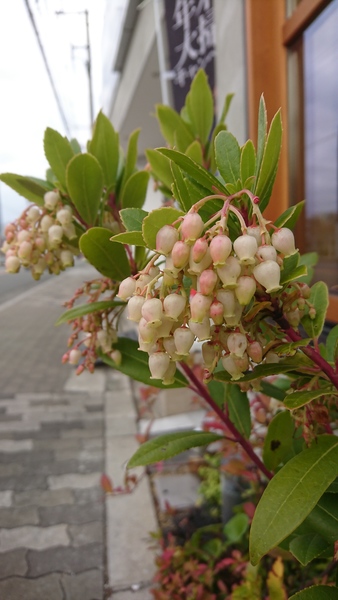
Arbutus unedo (strawberry tree, "Ichigonoki")
Japanese name: イチゴノキ (苺の木)
Scientific name: Arbutus unedo
[Overview]
An evergreen shrub or small tree about 3 m tall.
Rarely, it can reach 15 m in height with a trunk 80 cm in diameter.
It usually branches freely from near the base and grows densely, but it can also be grown as a single-trunk tree.
On mature trunks and branches, the gray-brown bark peels off to reveal reddish-brown inner bark.
Young branches and leaf stalks are often tinged with red.
The leaves are simple and alternate, 5–10 cm long and 2–3 cm wide, oblong to obovate, leathery, and glossy dark green on the upper surface.
The leaf margins have fine serrations.
Pendent panicles about 5 cm long emerge from the branch tips, bearing 10–30 flowers.
The flowers are white or tinged with pale pink; the corolla is urn-shaped, 5 mm across, with a shallowly 5-lobed tip.
The flowers have a faint sweet fragrance.
The fruit is a spherical berry 1–2 cm across, covered with small protrusions, and ripens red in the autumn of the following year, so flowers and fruit can be seen at the same time.
[Uses]
The fruit has a mild flavor but is processed into jam and other foods.
The leaves are used in folk medicine.
The wood is hard and is used as a material for pipes and other items.
[Cultivation]
Propagate from seed, cuttings, or layering.
It prefers a fertile, well-drained, moderately moist soil in sun to partial shade, and a site exposed to strong summer afternoon sun should be avoided.
Winter cold can damage the flowers and fruit, so avoid places exposed to cold wind as well.
It prefers acidic soil but also grows in alkaline soil.
For potted plants, water thoroughly when the soil surface dries; for plants in the ground, rainfall is sufficient unless summer brings a long sunny spell and the soil dries out.
As fertilizer in winter, apply organic fertilizer or slow-release fertilizer.
Hand-pollinating with a brush or similar during flowering makes fruit set easier.
Fruit yield drops if the plant suffers strong drought in summer or if frost falls during the flowering period.
The number of branches is not large and the tree shape naturally stays tidy, so do not prune; just thin out branches.
There are no particular pests or diseases, but aphids and scale insects may appear.
Details
Japanese: イチゴノキ(苺の木)、ストロベリーツリー
Translated from our Japanese encyclopedia. If anything differs, the Japanese page is correct.