
Plant Encyclopedia

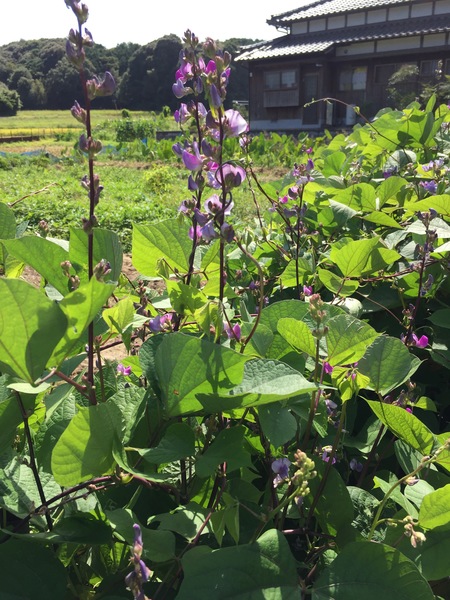
Lablab purpureus (hyacinth bean, "Fujimame")
Japanese name: フジマメ (藤豆)
Scientific name: Lablab purpureus
[Overview]
A climbing herb said to be native to tropical Africa.
It is a perennial in the tropics, but because it is sensitive to cold it is treated as an annual in Japan.
The vines grow long, usually reaching 2–3 m in height and sometimes 6 m.
The leaves are alternate and trifoliate; the leaflets are triangular-broadly ovate, 5–7 cm long.
The leaf margins are entire.
The leaves are often tinged with purple.
Long racemes stand upright from the leaf axils and bear reddish purple to pink or white pea-shaped flowers.
The axis of the inflorescence is reddish purple.
The fruit is a flat, glossy legume, reddish purple or greenish white, curved like a sickle, with a beak-like pointed tip.
[Uses]
The young pods and seeds are eaten, but mature seeds are toxic, so they should not be eaten in large quantities.
The seeds are also used medicinally.
It is grown in various regions as a traditional vegetable, for example Sengoku-mame in Gifu, Shirobana-sengoku in Aichi, and Kaga-tsurumame in Ishikawa.
[Cultivation]
Propagate from seed.
It dislikes transplanting, so sow directly where it will grow after the frosts have ended, or sow in plastic pots in a warm place indoors 6–8 weeks beforehand and raise seedlings.
It dislikes acidic soil.
The optimum growing temperature is 23–28°C, and growth slows below 13°C.
It prefers a sunny, well-drained place, and is vigorous and easy to grow.
Rainfall is sufficient for watering unless sunny weather continues and the soil becomes severely dry.
It grows vigorously and the vines become heavy, so sturdy supports are needed.
It dislikes being grown in the same place year after year.
Pests and diseases include ring spot, thrips, diamondback moths, spider mites and aphids.
[Notes]
In Kansai it is sometimes called ingen-mame.
Details
Japanese: フジマメ(藤豆)、センゴクマメ(千石豆)、ツルマメ(蔓豆)、インゲンマメ(隠元豆)、アジマメ(味豆)
Translated from our Japanese encyclopedia. If anything differs, the Japanese page is correct.