
Plant Encyclopedia

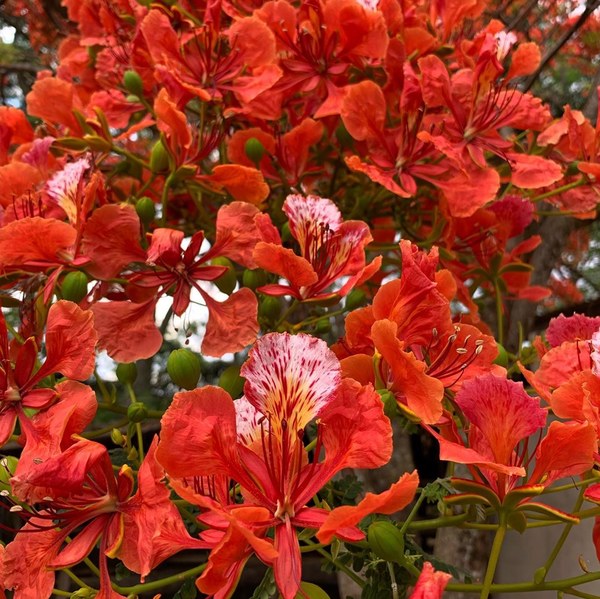
Delonix regia (royal poinciana, "Hoboku")
Japanese name: ホウオウボク (鳳凰木)
Scientific name: Delonix regia
[Overview]
An evergreen tree, but it loses its leaves in the dry season or when exposed to cold.
It usually reaches 9–12 m in height, spreads its branches flat like an umbrella, and the crown can be 18–21 m wide.
The leaves are alternate and bipinnately compound, 20–50 cm long, with 10–20 pairs of pinnae, each bearing 25–35 pairs of leaflets.
The leaflets are elliptic, about 1 cm long.
If the temperature suits it, it flowers almost all year round; in Okinawa it flowers from June to September.
Racemes at the branch tips bear scarlet to orange-red five-petaled flowers, 10 cm across, in such numbers that they cover the tree.
Of the petals, the upper one (the standard) is slightly larger and has a yellow and white pattern, which turns red after pollination.
The stamens are red.
There are 5 sepals, which are thick and fleshy, green on the outside and scarlet to orange-red on the inside.
The fruit is a legume, a flat oblong pod up to 60 cm long and 5 cm wide.
[History]
It is widely planted in the tropics and subtropics, but is threatened with extinction in its native habitat.
[Uses]
The leaves are used medicinally.
[Cultivation]
Propagate from seed or by cuttings.
When grown from seed, it is said that it often does not flower for 7–10 years.
It is sensitive to cold and frost, so grow it in regions without frost.
It is suitable for planting along the coast.
It prefers a sunny, well-drained place with sandy or loamy soil rich in organic matter, and dislikes heavy or clay soils.
In poor light it flowers poorly, and it flowers better when kept somewhat dry.
Because the branches spread like an umbrella, a fairly large space is needed.
In addition, the roots are strong and are said to sometimes lift paving.
Rainfall is sufficient for watering.
Fertilizer is not particularly necessary.
Pests include Hoo-bokukuchiba, Ao-dogane and Ryukyu-dogane.
[Notes]
It is one of the world's three great flowering trees.
Details
Japanese: ホウオウボク(鳳凰木)
Translated from our Japanese encyclopedia. If anything differs, the Japanese page is correct.