
Plant Encyclopedia

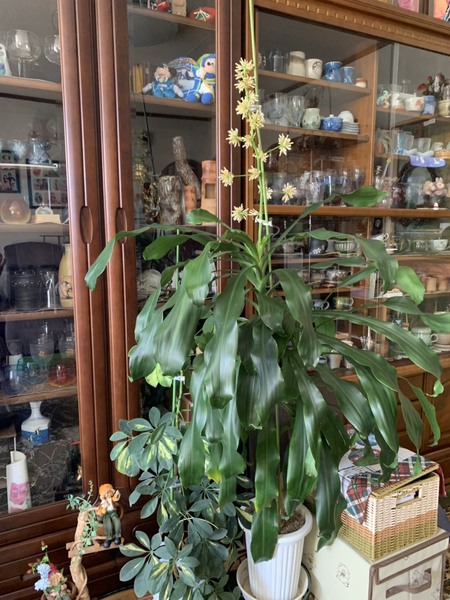
Dracaena fragrans (cornstalk dracaena, "Nioisennenboku")
Japanese name: ニオイセンネンボク
Scientific name: Dracaena fragrans
[Overview]
A slow-growing evergreen shrub to tall tree.
In its native habitat it reaches 6 m or more in height, sometimes even 15 m.
It does not have a fleshy rhizome.
Young plants have a single unbranched trunk, but when the grown tip flowers or is damaged, that part branches into two or more new trunks.
The branches are usually slender and erect, forming a narrow crown.
The leaves grow densely in clusters at the trunk and branch tips; they are glossy green, lanceolate, 20–150 cm long and 2–12 cm wide, and large leaves droop under their own weight.
As the plant grows, the lower leaves fall and the trunk becomes bare.
Panicles 15–160 cm long arise from the leaf axils, bearing many small 6-petaled flowers gathered in round heads.
The buds are tinged with pink, and when open the flowers are white to cream, with a thin red or purple line in the center of each tepal.
The flowers are fragrant.
There are no bracts at the base of the flowers.
The ovary is divided into 3 chambers, each with 1 ovule.
The fruit is a berry 1–2 cm in diameter that ripens orange-red.
When grown indoors as a foliage plant, flowers and fruit are hardly ever seen.
[Uses]
It is used as a foliage plant.
[Cultivation]
Propagate by cuttings, air layering, new-shoot cuttings or stem burying.
It is safest to keep it at 10°C or higher over winter.
It prefers fertile soil that is well drained, retains water and is well ventilated.
Variegated cultivars color poorly in poor light and can suffer leaf scorch in direct summer sun, so it is good to place them in a sunny spot from autumn to spring and in partial shade in summer.
Do not let it lack water or fertilizer during the growing season from spring to autumn.
From spring to autumn, water thoroughly when the soil surface dries; in winter, keep it on the dry side.
The leaf edges may dry out when humidity is insufficient, so mist the leaves all year round.
For fertilizer, from spring to autumn apply slow-release fertilizer once a month, or liquid fertilizer once a week.
Pests and diseases include soft rot, damping-off, scale insects, aphids and spider mites.
Details
Japanese: ニオイセンネンボク
Translated from our Japanese encyclopedia. If anything differs, the Japanese page is correct.