
Plant Encyclopedia

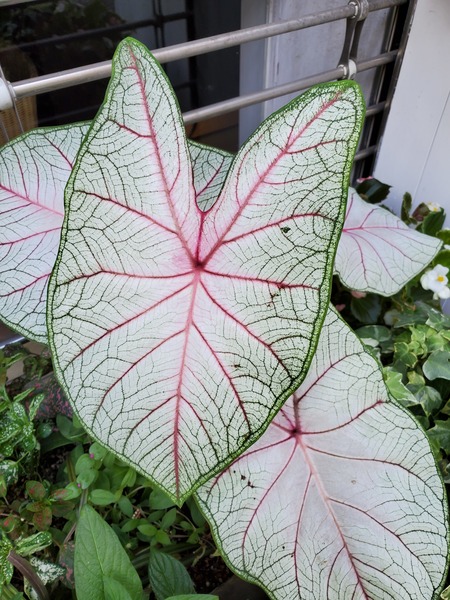
Caladium (genus, angel wings)
Japanese name: カラジウム
Scientific name: Caladium
[Overview]
A perennial grown as a foliage plant for the various patterns on its leaves.
It has tubers and goes dormant in the cold season or the dry season.
Many leaves arise from the base; they are usually arrowhead-shaped, with a long leaf stalk attached peltately.
The leaf surface bears various white, pink and red patterns.
The leaf margin is entire.
It produces a spadix enclosed in a spathe, with male flowers in the upper part of the inflorescence, bisexual flowers in the middle and female flowers in the lower part.
The fruit is a berry.
[Cultivation]
Propagate by dividing the tubers.
It goes dormant when temperatures fall below 20°C or when it becomes dry.
It prefers soil that is well drained and retains water well.
In spring, place it in a sunny spot; in midsummer, place it in bright shade, since direct sunlight can scorch the leaves.
Water thoroughly when the soil surface dries, and it is good to mist the leaves occasionally.
When temperatures drop in autumn and the leaves begin to turn yellow, gradually reduce watering; once the aboveground part has died back, stop watering or dig up the bulbs (tubers).
To store the bulbs, keep them at 10°C or higher, whether left planted or dug up.
Once flower buds form, the leaves stop growing, so when repotting the bulbs, check whether flower buds have appeared and remove them.
For fertilizer, apply liquid fertilizer once every 2 weeks during the growing period, or slow-release fertilizer once every 1–2 months.
Pests and diseases include southern blight, gray mold, spider mites, armyworms and greenhouse whiteflies.
Details
Japanese: カラジウム、カラジューム
Translated from our Japanese encyclopedia. If anything differs, the Japanese page is correct.