
Plant Encyclopedia

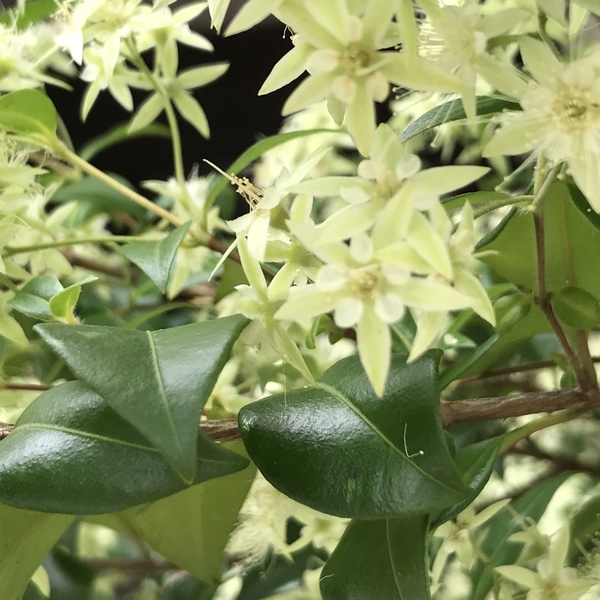
Backhousia myrtifolia (carrol)
Japanese name: シナモンマートル
Scientific name: Backhousia myrtifolia
[Overview]
An evergreen shrub or small tree; in its native range it grows at the edges of tropical rainforest, in valleys and along streams, and on dry, stony hills.
It is usually about 7 m tall, but is said to reach 30 m.
In large trees the base of the trunk sometimes forms buttress roots.
Young branches are hairy.
The leaves are simple and opposite, ovate to lanceolate, 2.5–7 cm long and 1–2.5 cm wide, with a pointed tip, and are dark green and glossy.
The leaf margin is entire.
The leaves have a cinnamon-like fragrance.
Flowers 1.5–2 cm across are borne in cymes from the leaf axils or in panicles from the branch tips.
The flowers are white to cream, with 4 petals, but the petals fall early, leaving the many long stamens and the calyx conspicuous.
The calyx is yellowish green, divided into 5 star-shaped lobes, and persists until the fruiting stage.
The fruit is a capsule.
[Uses]
The leaves are used for herbal tea and medicine, and also to flavor dishes.
An essential oil is obtained from the leaves.
The leaves can also be crushed and rubbed on the skin as an insect repellent.
The wood is hard and durable, and is used for tool handles and construction material.
[Cultivation]
Propagate mainly by cuttings (semi-ripe wood cuttings).
It can also be grown from seed; sow at temperatures of 13–15 °C, do not cover with soil, and water from below so it does not dry out until germination.
It can overwinter outdoors in warm areas without frost.
In cold regions, bring it indoors to a sunny place in winter.
It prefers fertile, moist soil that is sunny and well drained.
It dislikes frost and strong dryness.
Avoid places exposed to dry cold winter winds.
Take care not to let it dry out; for potted plants, and for plants in the ground less than 2 years after planting, water thoroughly from spring to autumn when the soil surface dries, and keep on the dry side in winter.
For plants in the ground that have taken root, rainfall is sufficient unless summer brings a long sunny spell and the soil dries out.
During the growing season from spring to autumn, apply slow-release fertilizer placed on the soil.
There are no particular pests or diseases.
Details
Japanese: シナモンマートル
Translated from our Japanese encyclopedia. If anything differs, the Japanese page is correct.