
Plant Encyclopedia

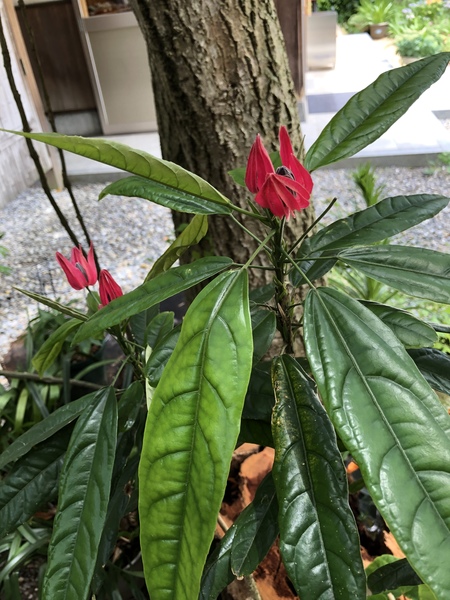
Pavonia ×gledhillii (Brazilian candle)
Japanese name: パボニア インテルメディア
Scientific name: Pavonia ×gledhillii
[Overview]
An evergreen shrub growing 0.5–2 m tall.
It branches sparsely, and the young branches are green.
The leaves are alternate and simple, elliptic-lanceolate, 10–16 cm long and 2.5–4 cm wide, with pointed tips and a glossy upper surface.
The leaf margins are entire or have very indistinct teeth.
The petiole is 2.5–5 cm long, and the stipules are linear-lanceolate, 2.5 cm long.
The flowers are borne singly in the upper leaf axils, and the flower stalk reaches 4 cm in length at flowering.
The flower has 5 petals, but the calyx and petals are dark purple and do not open, forming a tube about 3 cm long.
The staminal column protrudes from the flower, the anthers and pollen are purple, and the style is red with the tip divided into 9–10 lobes.
It bears 9–10 lanceolate involucral bracts in bright crimson to deep pink, which stand out like petals.
[History]
It was produced in the late 19th century by crossing Pavonia makoyana and Pavonia multiflora.
[Cultivation]
Propagate by cuttings.
To overwinter, keep it at 5°C or above, and in winter place it indoors in a sunny spot.
It prefers well-drained soil and dislikes excess moisture.
Grow it in full sun from autumn to spring, and in summer move it to a cool, airy place in partial shade.
From spring to autumn, water thoroughly when the soil surface dries; keep it on the dry side in winter.
In spring and autumn, place slow-release fertilizer on the soil or give liquid fertilizer.
Aphids can occur.
Details
Japanese: パボニア インテルメディア、パボニア インターメディア
Translated from our Japanese encyclopedia. If anything differs, the Japanese page is correct.