
Plant Encyclopedia

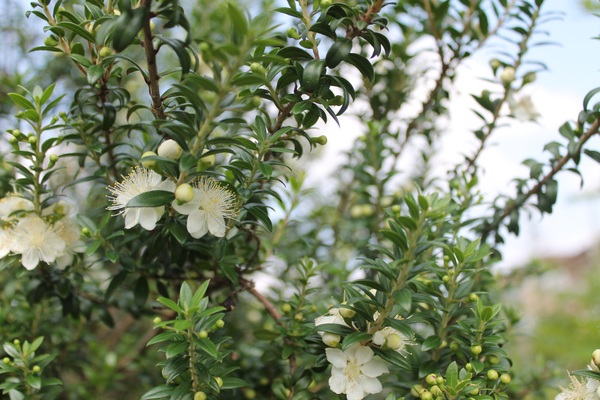
Myrtus communis subsp. tarentina (dwarf myrtle, "Kobanoginbaika")
Japanese name: コバノギンバイカ (小葉銀梅花)
Scientific name: Myrtus communis subsp. tarentina
[Overview]
An evergreen shrub about 1–1.5 m tall.
It grows slowly, branches well and grows densely.
The leaves are simple and opposite, narrowly ovate to lanceolate, 1–2 cm long, with entire margins and somewhat thick texture; the surface is dark green and glossy.
When rubbed, the leaves give off a strong scent resembling eucalyptus.
The flowers are borne singly in the leaf axils; they are white, 5-petaled, about 1.5–2 cm across, and the buds are tinged with pink.
The many long stamens are conspicuous.
The flowers are fragrant.
The fruit is a berry that ripens white or blackish purple.
[Cultivation]
Propagate from seed or by cuttings.
The germination rate of the seeds drops when they dry out, so harvest ripe fruit, wash off the pulp, bury the seeds in moistened vermiculite or similar so they do not dry out, store them in a cool, dark place, take them out the following spring, and wash them thoroughly again before sowing.
It dislikes transplanting when mature.
It can overwinter outdoors in regions without frost.
It prefers a sunny site with fertile, well-drained soil.
Avoid places exposed to cold winter winds.
For potted plants and plants within 2 years of being planted in the ground, water thoroughly when the soil surface dries; for established plants in the ground, rainfall is sufficient.
Apply organic fertilizer around the plant as fertilizer in winter.
It is often grown in its natural form, so trimming and pruning are not particularly necessary, but crowded branches inside the crown and long, weak shoots should be removed after flowering.
There are no particular pests or diseases.
Details
Japanese: コバノギンバイカ(小葉銀梅花)、ヒメギンバイカ(姫銀梅花)、ドワーフマートル
Translated from our Japanese encyclopedia. If anything differs, the Japanese page is correct.