
Plant Encyclopedia

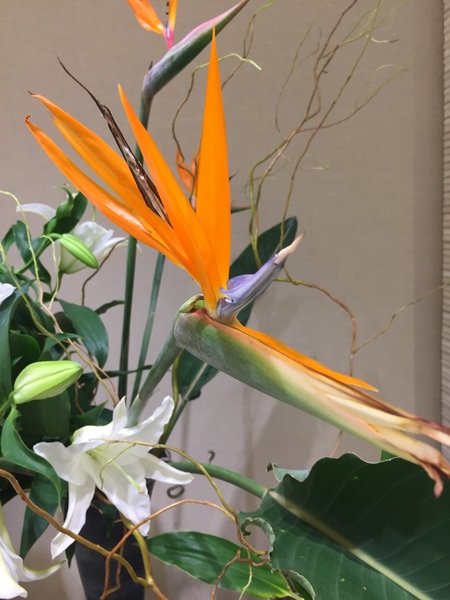
Strelitzia reginae (crane flower, "Gokurakuchoka")
Japanese name: ゴクラクチョウカ (極楽鳥花)
Scientific name: Strelitzia reginae
[Overview]
A stemless evergreen perennial 1–2 m tall.
It has a rhizome.
The leaves are borne in two rows in a fan shape; they are elliptic, 25–70 cm long and 10–30 cm wide, grayish, with thick, long petioles.
If the temperature is sufficient, it flowers throughout the year.
The flower stalk extends to about the same height as the leaves or taller.
At the tip of the flower stalk, a hard, boat-shaped, pointed bract 15–20 cm long is borne sideways, and several flowers bloom from within it.
The flower consists of 3 bright orange outer tepals and 3 blue-purple inner tepals; one of the inner tepals is very short, and the other two are fused into an arrow-like shape.
The whole flower is shaped like a bird's head.
The fruit is a capsule that splits open when ripe.
The seeds are black to brown, with an orange, thread-like aril.
[Cultivation]
Propagate by division.
If kept on the dry side in winter, it tolerates temperatures down to about 5°C, and it can overwinter outdoors in regions without frost.
In cold regions, bring it indoors to a sunny place in winter.
It prefers sunny, well-drained soil and grows in partial shade too, but flowering is poor if the light is poor.
Avoid the north wind in winter.
Take care not to overwater; from spring to autumn water thoroughly after the soil has dried, and keep it on the dry side in winter.
It tolerates dryness.
It is good to mist the leaves occasionally.
For plants in the ground, rainfall is sufficient.
From spring to autumn, place slow-release fertilizer on the soil.
Cut off dead leaves and flower stalks that have finished flowering at the base.
Pests include scale insects and spider mites.
Details
Japanese: ゴクラクチョウカ(極楽鳥花)、ストレリチア
Translated from our Japanese encyclopedia. If anything differs, the Japanese page is correct.