
Plant Encyclopedia

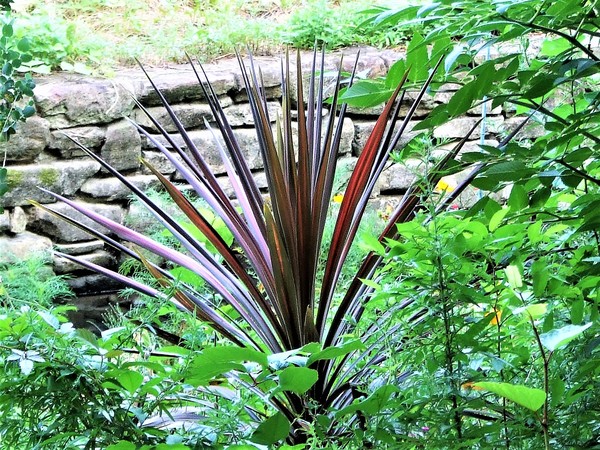
Cordyline australis (cabbage tree, "Nioishuroran")
Japanese name: ニオイシュロラン (匂棕櫚蘭)
Scientific name: Cordyline australis
[Overview]
In its native habitat, an evergreen tree up to 20 m tall.
It has a fleshy rhizome.
The bark is corky, and the trunk branches at the base and in the upper part.
The leaves are simple, densely clustered at the branch tips, lanceolate, 40–100 cm long, pointed at the tip, thick, with drooping tips.
Old leaves break off at the base and hang down.
The leaves are sessile.
From the leaf axils, panicles up to 60–100 cm long bear many small white 6-petaled flowers about 0.5 cm across, densely arranged.
The flowers are fragrant.
There are 3 bracts at the base of the flower.
The ovary is divided into 3 chambers, each with 6–15 ovules.
The fruit is a berry about 0.5 cm across, ripening white.
[Cultivation]
Propagate by stem cuttings, layering, or root cuttings.
It can be grown outdoors in frost-free areas south of Kanto.
It prefers well-drained, fertile soil.
For variegated cultivars, the color is poor in low light and direct summer sun can cause leaf scorch, so place them in a sunny spot from autumn to spring and in partial shade in summer.
During the growing season from spring to autumn, do not let it lack water or fertilizer.
From spring to autumn, water thoroughly when the soil surface dries, and keep on the dry side in winter.
Insufficient humidity can cause the leaf edges to wither, so mist the leaves all year round.
From spring to autumn, apply slow-release fertilizer once a month, or liquid fertilizer once a week.
Pests and diseases include soft rot, damping-off, scale insects, aphids and spider mites.
Details
Japanese: ニオイシュロラン(匂棕櫚蘭)
Translated from our Japanese encyclopedia. If anything differs, the Japanese page is correct.