
Plant Encyclopedia

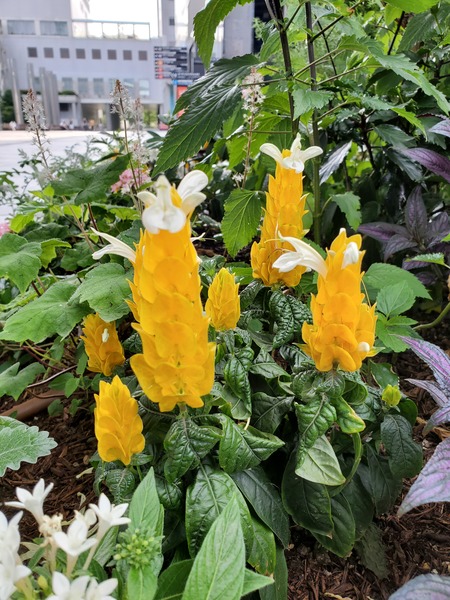
Pachystachys lutea (lollipop plant)
Japanese name: パキスタキス ルテア
Scientific name: Pachystachys lutea
[Overview]
An evergreen shrub 0.5–1.2 m tall, reaching 1.8 m in its native range.
The leaves are simple and opposite, long-ovate to oblong, 10–15 cm long and 3–5 cm wide, with conspicuous veins and short petioles.
The leaf margins are entire or have very low, rounded teeth.
It flowers all year round if kept at 13°C or higher.
Spike-like inflorescences 8–12 cm long emerge at the stem tips, with vivid yellow bracts arranged in 4 rows.
The bracts are obcordate, 2–2.5 cm long.
The flowers are white and two-lipped with a widely open tip; they emerge one at a time from between the bracts and are 4–5 cm long.
Each flower is short-lived, but they bloom one after another, and the bracts keep their color for a long time.
The fruit is a capsule.
[Cultivation]
Propagate by cuttings.
Keep it at 5°C or higher over winter.
The leaves may fall in the cold, but if the plant has not died, new shoots will emerge in spring.
It prefers fertile soil that drains well, retains water, and is moderately moist.
Partial shade in summer and a sunny place from autumn to spring suit it.
In poor light, flowering is poor.
Take care that it does not dry out; from spring to autumn water thoroughly when the soil surface dries, and keep it on the dry side in winter.
Take care that it does not run short of fertilizer; in addition to basal fertilizer, place slow-release fertilizer on the soil from spring to autumn, and it is also good to add liquid fertilizer once every 2 weeks during the flowering period.
Pinching off the buds at the branch tips increases side shoots and gives more flowers.
Pests and diseases include scale insects, aphids, greenhouse whiteflies and spider mites.
Details
Japanese: パキスタキス ルテア、ウコンサンゴバナ(鬱金珊瑚花)、シロエビソウ(白海老草)
Translated from our Japanese encyclopedia. If anything differs, the Japanese page is correct.