
Plant Encyclopedia

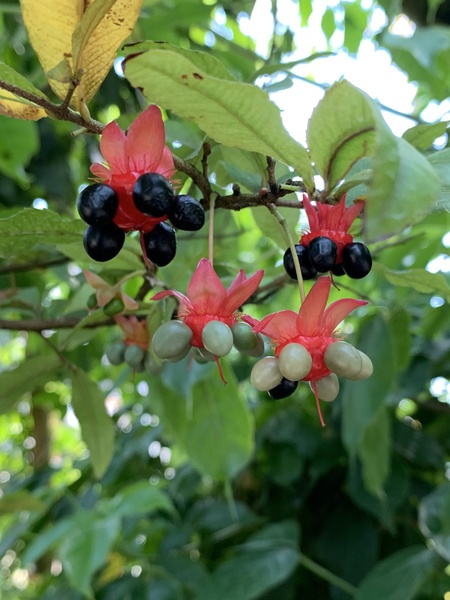
Ochna serrulata (Mickey mouse plant)
Japanese name: オクナ セルラタ
Scientific name: Ochna serrulata
[Overview]
An evergreen shrub 1–2.4 m tall, sometimes becoming a small tree of 6 m.
It branches well, and the bark has many yellowish-brown lenticels.
The leaves are simple and alternate, oblong, 3–6 cm long and 0.8–1.5 cm wide, leathery and glossy.
The leaf margins have fine teeth.
The flowers bloom downward in the leaf axils, one to several at a time; they are yellow, 2 cm across, with 5–6 petals and many stamens arranged radially.
The calyx at flowering time is yellowish green.
In the fruiting period the receptacle and calyx swell and turn red, and 5–6 fruits hang down.
The calyx curls back in the fruiting period, and the pistil remains at the center of the receptacle.
The fruit is an elliptical drupe about 0.5 cm across, yellowish green at first, ripening to glossy black.
Each fruit contains one seed.
[Cultivation]
Propagate from seed or by cuttings.
It has weak cold tolerance, so keep it at 10–13°C or higher over winter.
Even if it loses its leaves in the cold, it will not die and will sprout in spring if kept at about 7°C.
It prefers fertile soil with good sunlight, drainage and aeration.
It can also be grown in partial shade.
Keep potted plants outdoors from spring to autumn, and in a sunny place indoors in winter.
Take care that it does not dry out, and water thoroughly when the soil surface dries.
From spring to autumn, give liquid fertilizer once every 2 weeks, or place slow-release fertilizer on the soil once a month.
There are no particular pests or diseases.
Details
Japanese: オクナ セルラタ、ミッキーマウスの木、ミッキーマウスプランツ
Translated from our Japanese encyclopedia. If anything differs, the Japanese page is correct.