EVERGREEN

Plant Encyclopedia

Hebe

Hebe (genus)

Japanese name: ヘーベ
Scientific name: Hebe

Hebe

[Overview]
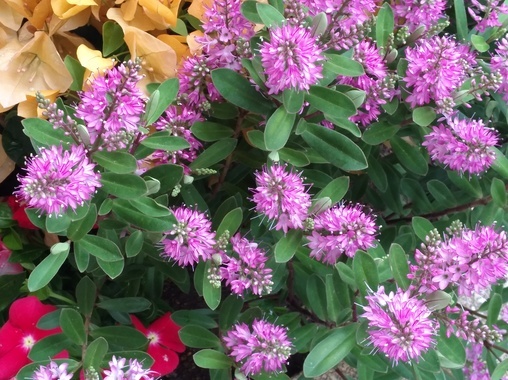
An evergreen shrub.
The leaves are simple and decussate (opposite, in alternating pairs), with entire margins or teeth.
Racemes or spikes arise from the leaf axils and bear dense flowers.
The corolla is 4-lobed, with 2 long stamens.
The calyx is also 4-lobed.
The fruit is a capsule.

[Cultivation]
Propagate by cuttings.
It is safer to keep it at 5°C or above for overwintering.
It prefers well-drained soil and should be placed in a sunny spot from autumn to spring.
It dislikes heat and humidity, so during long rainy spells and in summer, move it to an airy, partially shaded place.
Take care not to overwater, and water after the soil surface has dried.
Before and after flowering, apply slow-release fertilizer placed on the soil.
Thinning out crowded branches after flowering prevents the plant from becoming stuffy in the hot season.
Pests include scale insects and spider mites.

Details

Names
Japanese: ヘーベ
Life form
Shrub
Evergreen / deciduous
Evergreen
Leaf type
Broadleaf
Habit
Terrestrial
Planting (or sowing) season
June, July
Flowering season
March, April, May
Distribution or origin
New Zealand, Polynesia, South America, etc.
Growth form
Branching
Leaf shape
Simple leaf (unlobed)
Leaf arrangement
Opposite
Leaf margin
Entire, Dentate
Inflorescence
Raceme, Spike
Flower color
Red, Blue, Purple, Pink, White
Leaf color
Green
Availability of seeds and plants
Low
Form sold
Seedlings
Propagation
Cuttings
Sun exposure
Full sun, Partial shade
Water needs
Dry, Moderate
Soil needs
Required
Suitable uses
Potted plant, Container
Pests
Scale insects, Spider mites
Japan Flower Trade Code
22689

Translated from our Japanese encyclopedia. If anything differs, the Japanese page is correct.

Sponsored