
Plant Encyclopedia

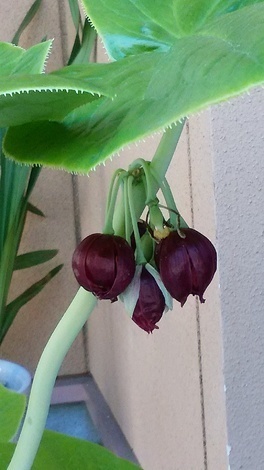
Dysosma pleiantha (Chinese mayapple, "Hakkakuren")
Japanese name: ハッカクレン (八角蓮)
Scientific name: Dysosma pleiantha
[Overview]
A perennial 20–60 cm tall, found in its native range in mountain forests and along valleys.
It has creeping underground stems.
The whole plant is hairless.
The stem is solitary and erect.
Two leaves grow opposite each other at the stem tip; they are 16–33 cm across and shallowly divided into 5–9 lobes, and the lobes are broadly triangular to triangular-ovate.
The upper surface of the leaves is glossy.
The leaf margins have fine spiny teeth.
The petiole is attached to the leaf in a peltate manner and is 10–28 cm long.
A pseudo-umbel arises from the fork of the petioles, bearing 5–8 nodding flowers.
The flowers are dark purple to purplish red with 6–9 petals, and the petals are obovate to elliptic, 3–4 cm long.
The stamens are as many as the petals, curved like a sickle, with flattened filaments.
The calyx is 1–2 cm long and falls early.
The flower stalk is 2–4 cm long.
The fruit is an elliptic berry about 3 cm long and 2 cm across, ripening to purplish black.
[Uses]
The rhizome is poisonous, but it is used medicinally for conditions such as venomous snake bites.
[Cultivation]
Propagate from seed, by division, or by root cuttings.
When growing from seed, sow immediately after harvesting.
It prefers partial shade to shade and fertile, well-drained soil that is moderately moist.
Root rot occurs easily in poorly drained soil.
Protect it from frost, for example with a cover, so that it does not suffer freezing or late frosts.
It dislikes dryness, so it is best to water every day.
It also needs quite a lot of fertilizer; apply slow-release fertilizer placed on the soil after the leaves emerge in spring, after flowering, and in autumn.
If you are not collecting seed, remove spent flowers early.
Pests include slugs and cutworms.
Details
Japanese: ハッカクレン(八角蓮)、ロッカクレン(六角蓮)、ミヤオソウ
Translated from our Japanese encyclopedia. If anything differs, the Japanese page is correct.