
Plant Encyclopedia

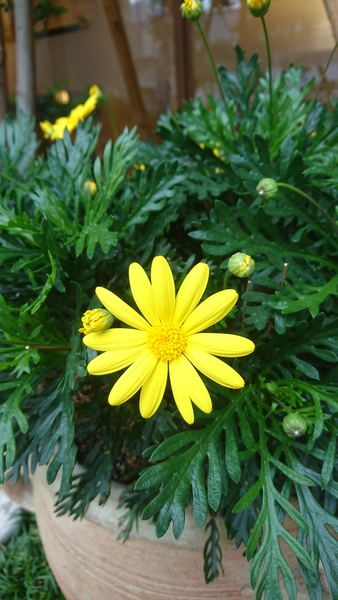
Euryops chrysanthemoides (African bush daisy)
Japanese name: マーガレットコスモス
Scientific name: Euryops chrysanthemoides
[Overview]
An evergreen shrub 0.5–2 m tall.
The base of the stem becomes woody.
The leaves are simple and alternate, pinnately divided into 7–9 pairs of lobes, with a smooth green upper surface.
The flowers are borne singly at the tips of flower stalks 10–15 cm long that come out at the branch tips, and are bright yellow flower heads 3–4 cm across.
Around the flower head there are 15–30 ray florets, and the tubular florets are also yellow.
The fruit is an achene.
[Cultivation]
Propagate by cuttings or shoot cuttings.
It prefers fertile, sunny, well-drained soil.
It can overwinter outdoors in areas without frost.
It tolerates dryness, but excess moisture can cause the base of the plant to rot, so during long rainy spells move potted plants to an airy place such as under the eaves.
For plants in the ground, mound up the soil or take similar measures so that rainwater runs off.
For potted plants, water thoroughly when the soil surface dries from spring to autumn, and keep it on the dry side in winter.
For plants in the ground, rainfall is sufficient.
Too much fertilizer makes it grow too dense, so use only basal fertilizer, or apply liquid fertilizer twice a month in spring and autumn.
It tolerates hard pruning, so if it becomes too dense, cut it back by about half in autumn.
Also, thin out branches and remove dead leaves as appropriate so that the inside of the plant does not become stuffy.
Aphids can occur.
They can be prevented by ensuring good air circulation and taking care not to over-fertilize.
Details
Japanese: マーガレットコスモス、ガモレピス、イエローエンジェル
Translated from our Japanese encyclopedia. If anything differs, the Japanese page is correct.