
Plant Encyclopedia

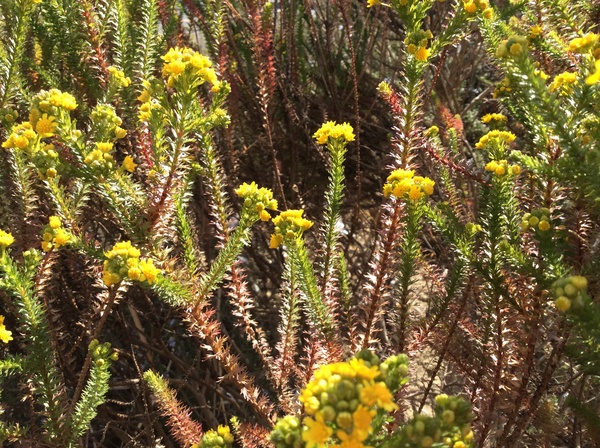
Euryops virgineus (honey euryops)
Japanese name: ゴールデンクラッカー
Scientific name: Euryops virgineus
[Overview]
An evergreen shrub growing to about 4 m tall.
The base of the stem becomes woody.
It branches freely, and the branches are rough with leaf scars.
The leaves are simple and alternate, overlapping one another, fan-shaped, 5–12 mm long and 2–7 mm wide, palmately divided into 3–7 lobes.
The flowers are borne singly from the leaf axils in the upper part of the stem, at the end of a flower stalk about 3 cm long, and are bright yellow flower heads 8–10 mm across.
The flowers have a sweet, honey-like fragrance.
The fruit is an achene.
[Cultivation]
Propagate by cuttings or bud cuttings.
It prefers sunny, well-drained, fertile soil.
Mature plants have some cold tolerance and can overwinter outdoors if the ground does not freeze, so it is best planted in a south-facing spot.
Protect it from frost, snow and cold wind.
It is tolerant of dryness, but excess moisture can cause the base of the plant to rot, so during long rainy spells move potted plants to an airy place such as under the eaves.
For plants in the ground, mound up the soil or otherwise make sure rainwater drains away.
For potted plants, water thoroughly when the soil surface dries from spring to autumn, and keep on the dry side in winter.
For plants in the ground, rainfall is sufficient.
Too much fertilizer makes the plant leggy, so use only base fertilizer, or apply liquid fertilizer once a month in spring and autumn.
It tolerates hard pruning, so if it becomes overgrown, cut it back by about half in May.
Also, thin out branches and remove dead leaves as appropriate so that the inside of the plant does not become stuffy.
Aphids can occur.
They can be prevented by ensuring good ventilation and taking care not to over-fertilize.
[Notes]
Golden Cracker is a trade name given to Euryops virgineus itself.
Details
Japanese: ゴールデンクラッカー、ウインタークラッカー、ハニーユーリオプス
Translated from our Japanese encyclopedia. If anything differs, the Japanese page is correct.