
Plant Encyclopedia

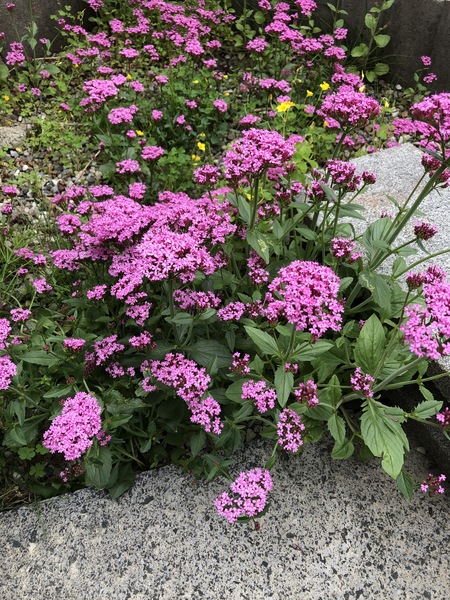
Centranthus ruber (red valerian, "Benikanokoso")
Japanese name: ベニカノコソウ (紅鹿子草)
Scientific name: Centranthus ruber
[Overview]
A perennial 45–90 cm tall.
Several stems arise, woody at the base, forming a bushy clump.
The leaves are simple and opposite, lanceolate to ovate, about 5–10 cm long, thick and covered with a white bloom.
The leaf margins are entire or slightly toothed.
Leaf stalks are present only on the leaves of the lower part of the stem.
Corymbs at the top of the stem bear many flowers.
The flowers are tubular with 5 lobes at the tip and deep crimson, though pink or white ones also exist.
The flower tube is long, with a long spur at the base.
The pistil protrudes out of the flower.
The seeds have a pappus.
[History]
It was introduced to Japan around the middle of the Meiji era.
[Uses]
The young leaves and roots are edible; the leaves are prepared as salad or a vegetable, and the roots are made into soup.
[Cultivation]
Propagate from seed or by division.
It also multiplies readily from self-sown seed.
It prefers slightly alkaline soil that is sunny, well drained and well ventilated.
It prefers dry conditions.
It tolerates partial shade, but flowering becomes poorer.
It can overwinter outdoors in the Kanto region and south.
For potted plants, water thoroughly when the soil surface dries; for plants in the ground, rainfall is sufficient.
Keep it on the dry side in winter.
Fertilizer is not particularly necessary, but for potted plants a small amount of slow-release fertilizer may be placed on the soil in spring.
If you are not collecting seed, cut the flower stalks after flowering so the plant does not become exhausted.
There are no particular pests or diseases.
Details
Japanese: ベニカノコソウ(紅鹿子草)、ヒカノコソウ(緋鹿子草)
Translated from our Japanese encyclopedia. If anything differs, the Japanese page is correct.