
Plant Encyclopedia

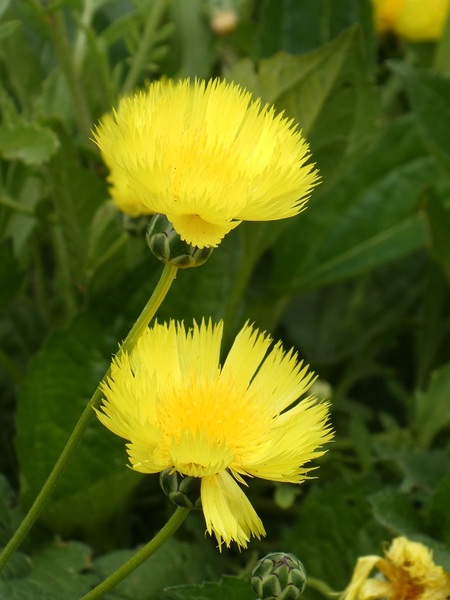
Amberboa amberboi (yellow sweet sultan)
Japanese name: イエローサルタン
Scientific name: Amberboa amberboi
[Overview]
An annual 60–80 cm tall.
The stems and leaves are hairless.
The stem is erect and sometimes branches.
There are basal leaves and leaves alternate on the stem, both pinnately divided.
A yellow flower head about 5–6 cm across is borne at the stem tip; it consists entirely of tubular florets, the outer ones are large and finely cut at the tips.
The involucre is ovate, and the involucral bracts overlap like roof tiles, with blackish-brown tips.
The flowers are fragrant.
The fruit is an achene with a pappus.
[History]
It was introduced to Japan in the Taisho era.
[Cultivation]
Propagate from seed.
It has a taproot and dislikes being transplanted, so sow directly where you want it to grow and thin out, or sow in plastic pots and transplant once 5–6 true leaves have appeared.
It is sensitive to cold, so protect it from frost when sown in autumn.
It prefers sunny, well-drained soil.
It is best planted in a well-ventilated place.
It dislikes excess moisture, so rainfall is sufficient for watering unless summer brings a long spell of sunny weather and severe dryness.
If a base fertilizer is applied, no further fertilizer is particularly necessary; if additional fertilizer is given, take care not to overdo nitrogen and apply it sparingly.
Too much fertilizer makes the plant leggy and prone to falling over.
The plant grows tall, so provide stakes.
Pests and diseases include damping-off, sclerotinia rot, aphids and whiteflies.
Details
Japanese: イエローサルタン、キバナニオイヤグルマ(黄花匂矢車)
Translated from our Japanese encyclopedia. If anything differs, the Japanese page is correct.