
Plant Encyclopedia

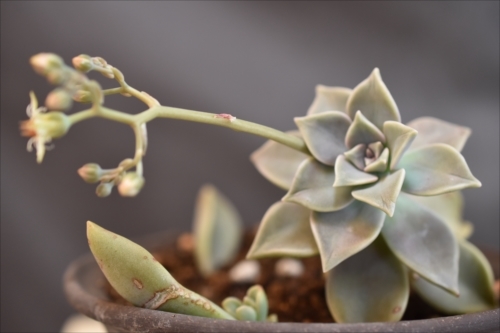
Graptopetalum paraguayense (ghost plant)
Japanese name: 朧月
Scientific name: Graptopetalum paraguayense
[Overview]
A succulent perennial.
It produces offsets freely.
The stem is about 1 cm in diameter; the base stands upright, but the tip creeps along the ground and extends far.
The leaves are alternate in rosettes at the stem tips, elliptic-spoon-shaped, 4–6 cm long and 2–3 cm wide, thick and pointed at the tip.
The leaves are grayish green with a powdery bloom, and often turn crimson in winter.
The leaves drop easily, and fallen leaves also root and become new plants.
Cymes arise from the leaf axils and bear 5–10 flowers.
The flowers are white, 2 cm across, 5-petaled, opening in a star shape, with red spots.
[Uses]
The leaves are sold as a vegetable.
[Cultivation]
Propagate by division or by leaf cuttings.
It prefers a sunny, well-drained, well-ventilated environment.
It can overwinter outdoors if protected from frost and cold wind.
It tolerates shade and slightly moist soil, but plenty of sun gives it its natural form.
Place pots on a shelf or similar so air can reach the bottom, and move them out of the rain during long rainy spells.
It dislikes heat and humidity, so in summer move it to cool, airy partial shade.
Water thoroughly only after the soil in the pot has dried all the way through.
Water collecting in the rosette can cause disease, so pour water gently around the edge of the pot.
Keep it on the dry side in winter.
In spring, apply a small amount of slow-release fertilizer.
Pests and diseases include rust, black spot, soft rot and scale insects.
Details
Japanese: 朧月
Translated from our Japanese encyclopedia. If anything differs, the Japanese page is correct.