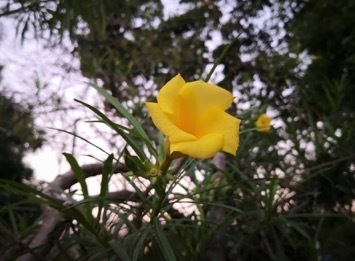
Japanese name: キバナキョウチクトウ(黄花夾竹桃) Scientific name:Thevetia peruviana
[Overview]
An evergreen shrub about 5 m tall.
White latex exudes when the stems or leaves are damaged.
Leaves are simple and alternate, slightly spiral, linear, about 15 cm long and 0.6 cm wide, with a distinct midrib and a glossy upper surface.
The leaf margin is entire.
In regions with sufficiently high temperatures, it flowers all year round.
Cymes at the branch tips bear funnel-shaped yellow flowers 3–4 cm across.
The corolla is 5-lobed, half-open and fragrant.
The fruit is a triangular pyramid-shaped drupe that ripens to black.
[Uses]
Although poisonous, the fruit, leaves and bark are used medicinally.
[Cultivation]
Propagate from seed or by cuttings.
Take cuttings and transplant when temperatures are 25°C or higher.
It can overwinter outdoors in warm regions.
It prefers fertile sandy soil that is sunny and well drained.
It tolerates dryness, so rainfall is sufficient.
A small amount of organic fertilizer applied around the plant in winter or early spring is enough.
Pests and diseases include scale insects and aphids.