
Plant Encyclopedia

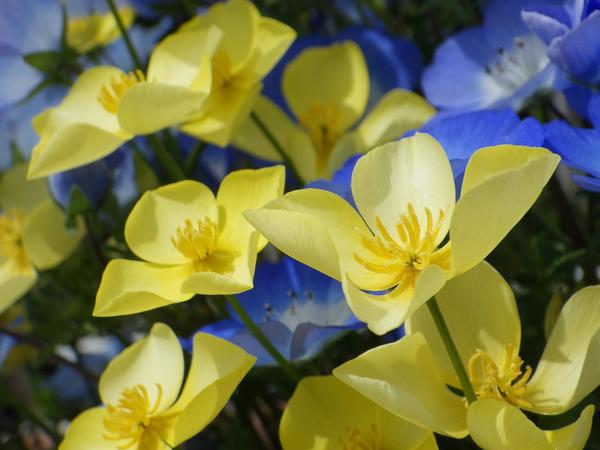
Eschscholzia caespitosa (foothill poppy, "Himehanabishiso")
Japanese name: ヒメハナビシソウ (姫花菱草)
Scientific name: Eschscholzia caespitosa
[Overview]
An annual 20–30 cm tall.
The stems and leaves are tinged with a powdery white bloom.
The stem branches readily at the base.
The leaves are alternate and finely divided.
The flowers are borne singly on long stalks from the leaf axils in the upper part of the stem; they are about 2–3 cm across, pale yellow, with 4 petals.
The petals are rhombic.
The fruit is a slender capsule 4–8 cm long.
[Cultivation]
Propagate from seed.
It has a taproot and dislikes transplanting, so sow directly, or sow in pots and transplant in spring.
If plants are too close together, flowering becomes poor and diseases such as root rot appear more easily, so thin them to about 20 cm apart.
Its cold tolerance is –5°C, so when sowing in autumn, protect it from frost in winter.
It prefers sun, good air circulation and well-drained soil.
It dislikes heat and humidity.
Take care that it does not become too wet when watering; for potted plants, water thoroughly after the soil has dried, and for plants in the ground, rainfall is sufficient.
Fertilizer is not particularly needed if base fertilizer is applied; too much fertilizer makes the plants leggy and prone to falling over.
Pests and diseases include root rot, downy mildew and damping-off.
Details
Japanese: ヒメハナビシソウ(姫花菱草)
Translated from our Japanese encyclopedia. If anything differs, the Japanese page is correct.