
Plant Encyclopedia

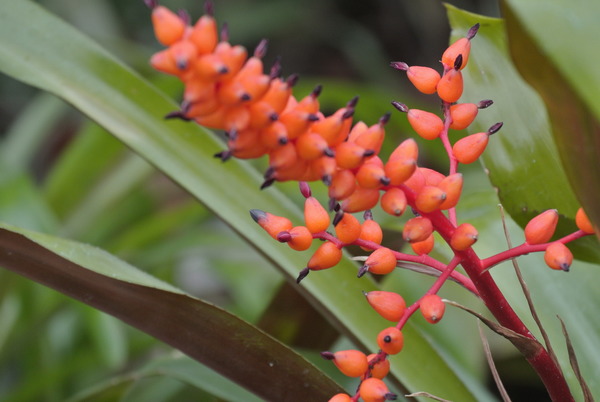
Aechmea fulgens var. discolor ("Urabenisangoananasu")
Japanese name: ウラベニサンゴアナナス
Scientific name: Aechmea fulgens var. discolor
[Overview]
A perennial that grows epiphytically on rocks and trees.
The leaves form a rosette; they are linear, 35–45 cm long and 6–7 cm wide, with fine spines on the margins.
The undersides of the leaves are tinged reddish purple to reddish brown and heavily covered with white powder.
The leaf bases overlap to form a tube; in its native range, water collects here, and the plant grows by absorbing nutrients and moisture through the leaves as well.
The flower stalk is upright and bears a panicle 20 cm long with 80–100 flowers.
The flowers are small, bluish purple and 3-petaled, but short-lived; the coral bead-like reddish orange calyx remains for a long time and is conspicuous.
Once a plant has flowered, it produces offsets and dies.
The fruit is a berry.
[Cultivation]
Propagate by division.
A plant that has flowered dies after producing offsets, so the offsets are used to renew the plants.
Plant in sphagnum moss.
A temperature of 10–12°C is safe for overwintering.
From spring to autumn, keep it in bright, airy shade; in winter, place it by a sunny window or similar.
Direct summer sun causes leaf scorch.
From spring to autumn, fill the tube formed by the leaves with water, pouring generously each time so that the water is replaced.
When temperatures begin to fall, turn the plant upside down to empty the water, and in winter water only the soil.
It prefers high air humidity, so mist the leaves throughout the year.
Apply slow-release chemical fertilizer once every 2–3 months from spring to autumn.
When the color of the inflorescence fades after flowering, cut off the flower stalk so that nutrients go to the offsets.
Pests include scale insects and spider mites.
Details
Translated from our Japanese encyclopedia. If anything differs, the Japanese page is correct.