EVERGREEN

Plant Encyclopedia

Heptacodium miconioides

Heptacodium miconioides (seven son flower, "Nanakobana")

Japanese name: ナナコバナ (七子花)
Scientific name: Heptacodium miconioides

Heptacodium miconioides

[Overview]
A deciduous shrub or small tree 4–9 m tall, found in its native range at woodland edges and on clifftops.
The bark peels off in thin pieces.
It branches well, and the young branches are ridged and tinged with red.
The leaves are simple and opposite, ovate, 8–15 cm long and 5–9 cm wide, with entire margins.
The petiole is about 1 cm long.
A panicle-like or head-like inflorescence 5–15 cm long at the branch tips bears many small flowers.
The flowers are white and fragrant, with a 5-lobed corolla.
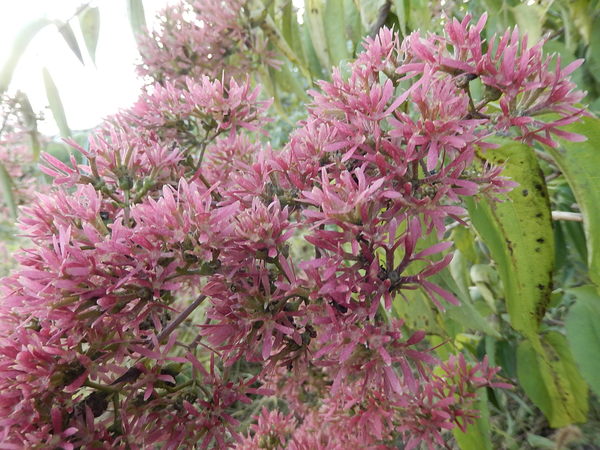
After flowering, the sepals develop into red, shuttlecock-like structures that remain conspicuous until late autumn.

[Cultivation]
Propagate from seed or by cuttings.
It prefers a sunny, well-drained site.

Details

Names
English: seven son flower
Japanese: ナナコバナ(七子花)、オータムライラック
Life form
Shrub, Small tree
Evergreen / deciduous
Deciduous
Leaf type
Broadleaf
Habit
Terrestrial
Planting (or sowing) season
October, November, February, March
Flowering season
July, August, September
Fruiting season
September, October, November
Distribution or origin
Eastern to central China
Height
4000–9000 mm
Leaf shape
Simple leaf (unlobed)
Leaf arrangement
Opposite
Leaf margin
Entire
Inflorescence
Panicle
Flower color
White
Inflorescence length
50–150
Leaf color
Green
Availability of seeds and plants
Low
Form sold
Seedlings
Propagation
Seed, Cuttings
Sun exposure
Full sun
Water needs
Moderate
Soil needs
Required
Tolerance
Cold tolerance, Shade tolerance
Suitable uses
Parks and gardens
Japan Flower Trade Code
88706

Translated from our Japanese encyclopedia. If anything differs, the Japanese page is correct.

Sponsored