EVERGREEN

Plant Encyclopedia

Heliotropium arborescens

Heliotropium arborescens (garden heliotrope)

Japanese name: ヘリオトロープ
Scientific name: Heliotropium arborescens

Heliotropium arborescens

[Overview]
A perennial or subshrub 30–50 cm tall.
It is hairy all over.
The stems branch and become woody at the base.
The leaves are simple and alternate, ovate to elliptic, 4–8 cm long, with wrinkles along the veins.
They have leaf stalks.
The leaf bases clasp the stem.
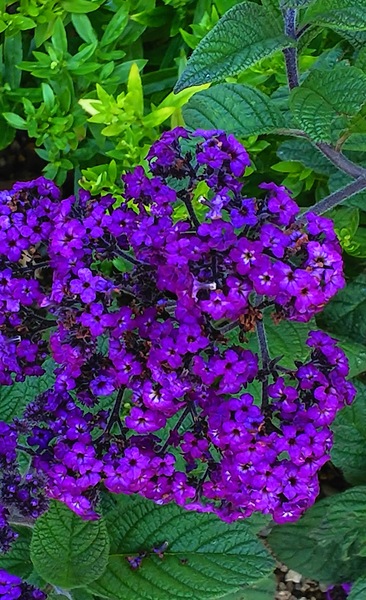
Cymes at the stem tips bear dense flowers.
The flowers are bluish purple to purple; the corolla is 5-lobed and has a vanilla-like fragrance.
There are also white-flowered plants.
The fruit is a schizocarp.

[Uses]
The flowers are used as a perfume ingredient, and the leaves are applied externally for insect bites.

[Cultivation]
Propagate by stem cuttings.
It can overwinter outdoors in regions without frost.
It prefers sunny, well-drained soil that retains moisture and is well aerated, and dislikes acidic soil.
Water thoroughly when the soil surface dries.
Apply basal fertilizer, and also slow-release fertilizer in spring and autumn.
Remove spent flowers promptly.
Pests include cottony cushion scale and aphids.

Details

Names
English: garden heliotrope, common heliotrope, cherry pie
Japanese: ヘリオトロープ、キダチルリソウ(木立瑠璃草)、ニオイムラサキ(匂紫)
Life form
Perennial, Subshrub
Habit
Terrestrial
Planting (or sowing) season
April, May, June, September, October
Flowering season
April, May, June, July, August, September, October
Distribution or origin
Peru
Height
300–500 mm
Leaf shape
Simple leaf (unlobed)
Leaf arrangement
Alternate
Inflorescence
Cyme
Flower color
Blue, Purple, White
Leaf color
Green
Availability of seeds and plants
Low
Form sold
Seeds, Seedlings
Propagation
Bud cuttings
Sun exposure
Full sun
Water needs
Moderate
Soil needs
Required
Soil acidity
Alkaline, Neutral
Tolerance
Cold intolerance
Suitable uses
Potted plant, Flower bed, Parks and gardens, Container
Hardiness zone
9a–11b
Pests
Cottony cushion scales, Aphids
Uses
Medicinal, Essential oil
Japan Flower Trade Code
28134

Translated from our Japanese encyclopedia. If anything differs, the Japanese page is correct.

Sponsored