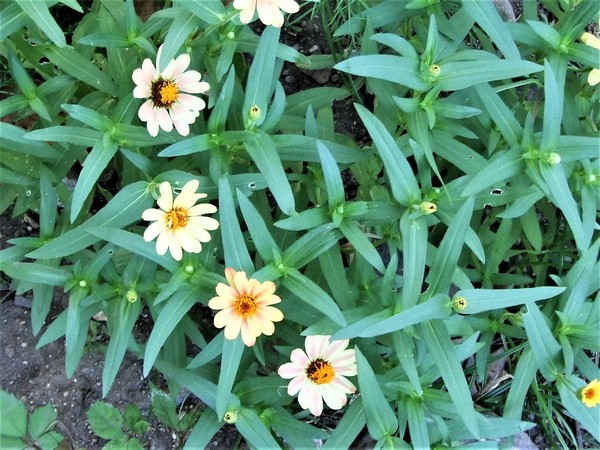
Japanese name: ホソバヒャクニチソウ(細葉百日草) Scientific name:Zinnia angustifolia
[Overview]
An annual 20–50 cm tall.
The stems are much branched and have short hairs.
The leaves are simple and opposite, lanceolate, 2–7 cm long and 0.4–0.8 cm wide, with entire margins.
A single head-like inflorescence is borne at the end of each branch; in the wild species, the ray flowers around the edge of the inflorescence are orange to yellow, and the tubular flowers in the center are yellow.
[Cultivation]
Propagate from seed or by cuttings.
It prefers a sunny, airy site with soil that is well drained and retains water well.
If the site is not sunny enough, flowering becomes poor or the flowers become small.
Water thoroughly when the soil surface dries.
In addition to basal fertilizer, apply chemical fertilizer once a month or liquid fertilizer about once every 10 days, continuing until the flowering period.
When the flowers have finished, cut the stems back from the topmost bud to a few nodes below; the side buds will then grow and you can enjoy a second flush of flowers.
Pests and diseases include powdery mildew, aphids and spider mites.