EVERGREEN

Plant Encyclopedia

Nierembergia

Nierembergia (genus, cupflower)

Japanese name: ニーレンベルギア
Scientific name: Nierembergia

Nierembergia

[Overview]
A perennial or subshrub.
The leaves are simple and alternate, linear to spatulate, with smooth margins.
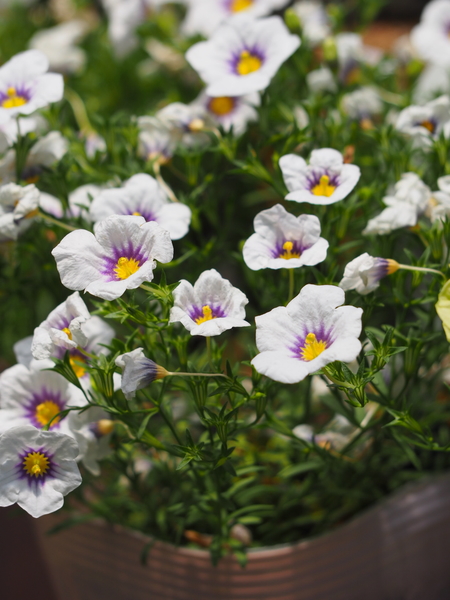
The flowers are borne in cymes arising from the leaf axils or singly; the corolla is funnel-shaped, shallowly 5-lobed, and opens upward.
There are 5 stamens, one of which is a staminode.
The fruit is a capsule.

[Cultivation]
Propagate from seed or by stem cuttings.
It prefers fertile soil in a sunny, well-drained, well-ventilated place.
It dislikes heat and humidity.
For potted plants, water thoroughly when the soil surface dries; for plants in the ground, rainfall is sufficient.
From spring to autumn, apply slow-release fertilizer placed on the soil.
Pests and diseases include aphids, spider mites and slugs.

Details

Names
English: cupflower
Japanese: ニーレンベルギア
Life form
Perennial, Subshrub
Habit
Terrestrial
Planting (or sowing) season
April, May, September, October
Flowering season
May, June, July, August, September
Distribution or origin
Tropical America
Leaf shape
Simple leaf (unlobed), Linear
Leaf arrangement
Alternate
Leaf margin
Entire
Inflorescence
Solitary, Cyme
Flower color
Blue, Purple, White, Multicolor
Leaf color
Green
Availability of seeds and plants
Low
Form sold
Seeds, Seedlings
Propagation
Seed, Bud cuttings
Sun exposure
Full sun
Water needs
Moderate
Soil needs
Required
Suitable uses
Ground cover, Rock garden, Potted plant, Flower bed, Cut flowers, Parks and gardens, Rooftop greening
Pests
Aphids, Spider mites, Slugs
Japan Flower Trade Code
22730

Translated from our Japanese encyclopedia. If anything differs, the Japanese page is correct.

Sponsored