EVERGREEN

Plant Encyclopedia

Perovskia atriplicifolia

Perovskia atriplicifolia (Russian sage)

Japanese name: ロシアンセージ
Scientific name: Perovskia atriplicifolia

Perovskia atriplicifolia

[Overview]
A perennial or subshrub 0.5–1.2 m tall.
The whole plant is grayish green and has a sage-like fragrance.
The stem is square in cross section.
The leaves are opposite, ovate to lanceolate, 3–5 cm long and 0.4–2 cm wide, and often deeply cut.
The leaf margins are wavy or toothed.
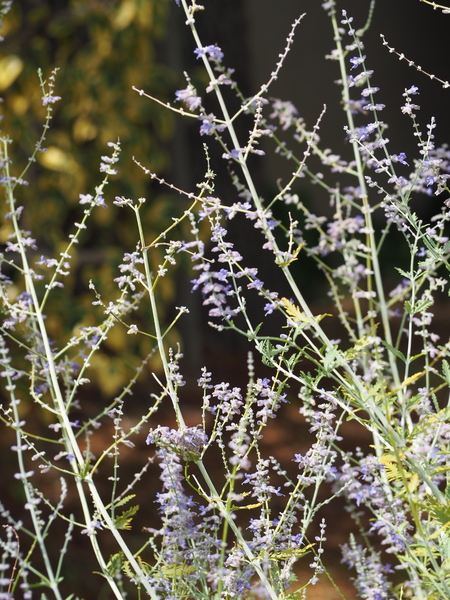
A panicle about 30 cm long at the stem tip bears many bluish purple lipped flowers about 1 cm long.
The fruit is a schizocarp.

[Cultivation]
Propagate from seed or by stem cuttings.
It prefers a sunny, well-drained site.
It tolerates dryness and dislikes excess moisture, so rainfall is sufficient.
Fertilizer is not particularly necessary.
There are no particular pests or diseases.

Details

Names
English: Russian sage
Japanese: ロシアンセージ、サマーラベンダー
Life form
Perennial, Subshrub
Habit
Terrestrial
Planting (or sowing) season
March, April, September, October
Flowering season
July, August, September, October
Distribution or origin
Western China, Pakistan, Afghanistan, Iran, Turkey, eastern Europe
Height
500–1200 mm
Leaf shape
Simple leaf (unlobed), Lobed leaf
Leaf arrangement
Opposite
Leaf margin
Undulate, Serrate
Inflorescence
Raceme, Panicle
Flower color
Purple, Blue
Inflorescence length
300
Availability of seeds and plants
Low
Form sold
Seedlings
Propagation
Seed, Bud cuttings
Sun exposure
Full sun
Water needs
Moderate
Soil needs
Required
Tolerance
Cold tolerance, Drought tolerance
Suitable uses
Flower bed, Parks and gardens
Hardiness zone
6b
Japan Flower Trade Code
61149

Translated from our Japanese encyclopedia. If anything differs, the Japanese page is correct.

Sponsored