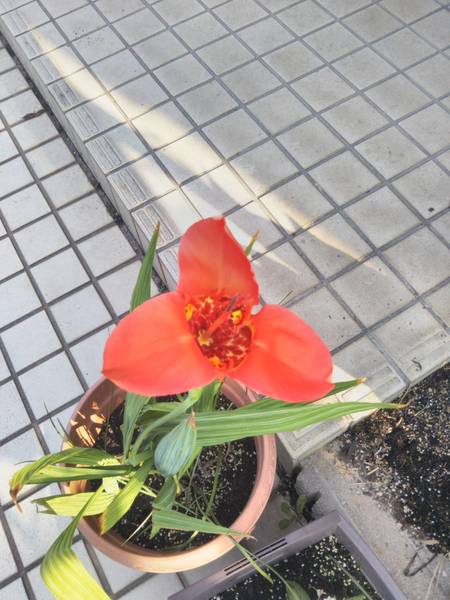
Japanese name: チグリジア パヴォニア Scientific name:Tigridia pavonia
[Overview]
A perennial 1.5 m tall.
It has an underground bulb.
Two to three leaves emerge in a fan shape; they are sword-shaped, 20–50 cm long, and have lengthwise wrinkles.
Two to five flowers 10–15 cm across are borne at the stem tip.
The flowers open facing upward and have 6 tepals; the inner 3 are small, and the outer 3 are large and spreading.
A tiger-stripe pattern marks the center of the flower.
The flowers last one day, opening in the morning and wilting by evening.
[Cultivation]
Propagate from seed or by dividing the bulbs.
It prefers sunny, well-drained sandy soil.
It dislikes excess moisture, so when planting in the ground, plant under the eaves or make a mound so that rainwater drains away.
Rainfall is sufficient for watering.
Fertilizer is not particularly necessary.
When the leaves turn yellow, dig up the bulbs, divide them, and store them dry in a place where they will not freeze.
Pests and diseases include neck rot, viral disease, cutworms and spider mites.