
Plant Encyclopedia

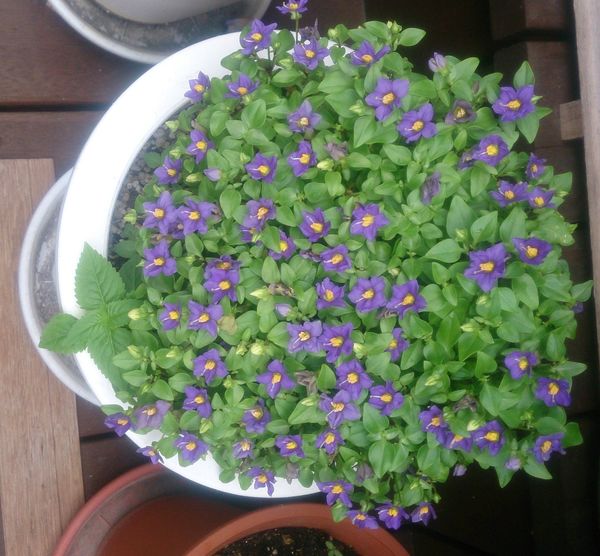
Exacum affine (Persian violet, "Benihimerindo")
Japanese name: ベニヒメリンドウ (紅姫竜胆)
Scientific name: Exacum affine
[Overview]
A short-lived perennial treated as an annual sown in spring or autumn.
It branches well and grows in a dense mound.
The leaves are simple and opposite, broadly ovate, glossy on the surface, and entire.
They have petioles.
The flowers are borne in the leaf axils of the upper stem and are about 1.5 cm across; the corolla is 4–5-lobed.
The yellow anthers of the stamens stand out.
There are also double-flowered cultivars.
The fruit is a capsule.
[History]
It was introduced to Japan around 1928.
[Cultivation]
Propagate from seed or by stem cuttings.
The seeds need light to germinate, so sow them in seed-sowing soil without covering them with soil, and water from the bottom so the soil does not dry out.
A temperature of about 20°C is needed for germination.
Seedlings grow slowly and are susceptible to dryness and damping-off.
It somewhat dislikes being transplanted.
It will grow in winter as long as the temperature is kept at 10°C or above.
It prefers a sunny, airy, well-drained, somewhat sandy soil.
It dislikes strong direct sunlight in summer, so move potted plants to an airy place in partial shade.
When watering, take care not to make the soil too wet; for potted plants, water thoroughly after the soil has dried, and for plants in the ground, rainfall is sufficient.
During the growing season, apply diluted liquid fertilizer once every 2 weeks.
Pests and diseases include damping-off, aphids and spider mites.
Details
Japanese: ベニヒメリンドウ(紅姫竜胆)、エキザカム
Translated from our Japanese encyclopedia. If anything differs, the Japanese page is correct.