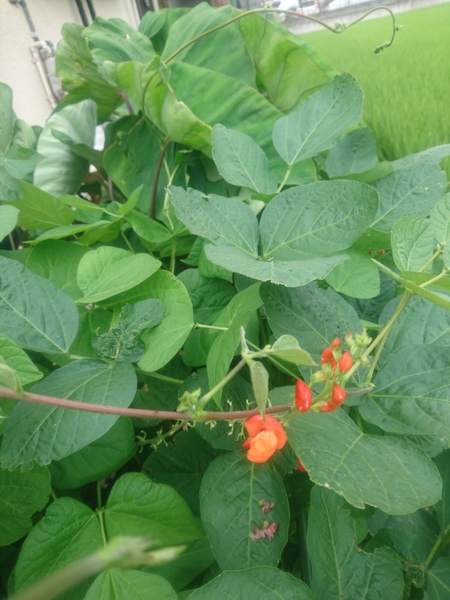
Japanese name: ベニバナインゲン(紅花隠元) Scientific name:Phaseolus coccineus
[Overview]
A climbing perennial, but treated as an annual in Japan.
It has tuberous roots.
The vines can grow more than 3 m long and climb by twining around other objects.
The leaves are alternate and trifoliate, with entire margins and long petioles.
Racemes arise from the leaf axils and bear vermilion pea-type flowers.
The flowers are characterized by the keel petal, which encloses the stamens and pistil, coiling back through one full turn.
The fruit is a flat pod about 10 cm long.
The seeds (beans) are kidney-shaped, purple with black spots.
[History]
It was introduced to Japan in the late Edo period.
[Uses]
The fully ripe seeds (beans) are eaten.
[Cultivation]
It prefers a somewhat cool environment, and as long as the site is sunny and well drained, it is not particular about soil.
At temperatures of 25°C or above, flowers and pods tend to drop.