
Plant Encyclopedia

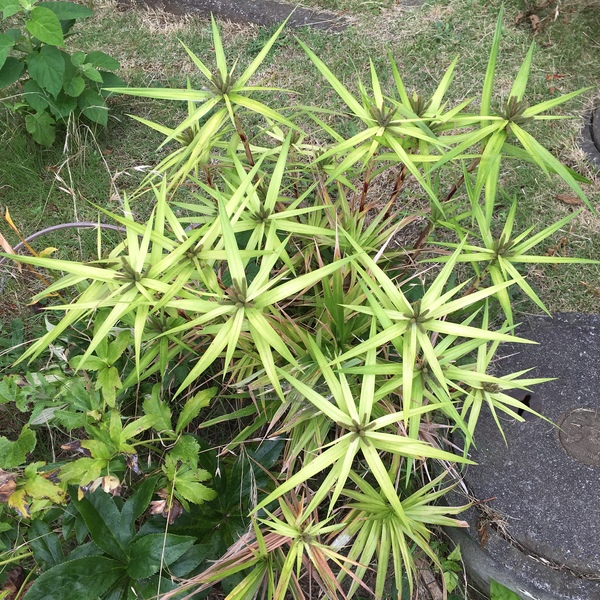
Carex phyllocephala ("Tenjikusuge")
Japanese name: テンジクスゲ (天竺菅)
Scientific name: Carex phyllocephala
[Overview]
In its native range, a perennial 20–60 cm tall found in forests, valleys, and moist places along roadsides.
It has a short rhizome and does not produce stolons.
The upper part of the stem is bluntly triangular in cross section, and the base has a reddish brown sheath.
The leaves are arranged alternately in a spiral on the upper part of the stem; they are lanceolate, 0.8–1.5 cm wide, and firm in texture.
6–10 spikelets are borne at the stem tip, with bracts of the same shape as the leaves.
The terminal spikelet is male and linear, 1–2.5 cm long; the lateral spikelets are female and narrowly cylindrical, 2–3 cm long.
The lateral spikelets often have a male flower part at the top.
The scales of the female flowers are ovate and green.
The stigma is divided into 3.
The perigynium is ovate, 2.8–3.5 mm long, densely covered with white bristles, and beaked at the top.
[Cultivation]
Propagate from seed or by division.
The seeds need light to germinate, so cover them with only a very thin layer of soil.
It grows in sun to partial shade and prefers moderately moist soil that drains well and retains water.
For plants in the ground, avoid places with strong afternoon sun or places that become dry.
It also spreads by extending underground stems, so to prevent excessive spreading, build a frame underground or plant it in a large pot before burying it.
Take care that it does not become too dry; for potted plants, water thoroughly when the soil surface dries, and for plants in the ground, rainfall is sufficient if the site suits it.
Once a base fertilizer has been applied, no further fertilizer is particularly necessary.
There are no particular pests or diseases.
Details
Translated from our Japanese encyclopedia. If anything differs, the Japanese page is correct.