EVERGREEN

Plant Encyclopedia

Gypsophila paniculata

Gypsophila paniculata (baby's breath, "Shukkonkasumiso")

Japanese name: シュッコンカスミソウ (宿根霞草)
Scientific name: Gypsophila paniculata

Gypsophila paniculata

[Overview]
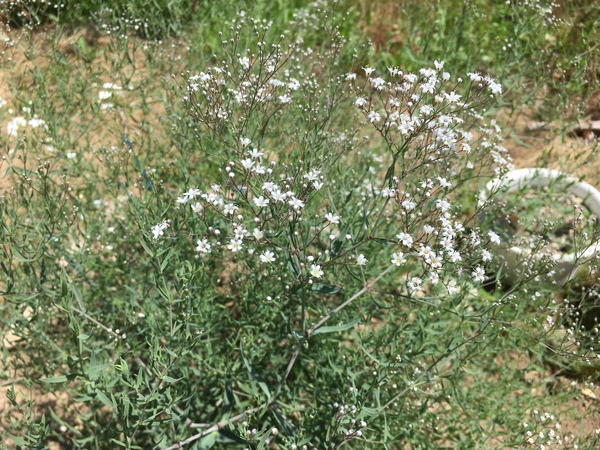
A perennial growing to 1.2 m tall.
It has a fleshy rhizome.
The whole plant is tinged with a powdery white and is usually hairless.
The stems are slender, erect, and branch well.
The leaves are simple, decussate, linear-lanceolate, and entire.
Dichasial inflorescences bear many white or pink flowers, which open starting from the tip of the inflorescence.

[History]
It was introduced to Europe in 1759.

[Cultivation]
Propagate from seed or by stem cuttings.
Sow in autumn in warm regions and in spring in cold regions.
It prefers a sunny, well-drained, well-ventilated place.
It dislikes acidic soil and excess moisture.
It is easier to grow in somewhat dry, poor soil.
Rainfall is sufficient for watering.
Once a base fertilizer has been applied, no further fertilizer is particularly necessary.
Too much fertilizer makes the plant leggy and less likely to flower.
The plant grows tall, so provide a stake.
Pests and diseases include damping-off and aphids.

Details

Names
English: baby's breath, panicled baby's-breath, common gypsophila
Japanese: シュッコンカスミソウ(宿根霞草)、コゴメナデシコ(小米撫子)
Life form
Perennial
Habit
Terrestrial
Planting (or sowing) season
February, March, April, October, November
Flowering season
June, July, August
Distribution or origin
Europe (central, eastern) to Central Asia
Height
1200 mm
Leaf shape
Simple leaf (unlobed)
Leaf arrangement
Opposite
Leaf margin
Entire
Inflorescence
Dichasium (dichasial cyme)
Flower color
Pink, White
Leaf color
Green
Availability of seeds and plants
Low
Form sold
Seeds, Seedlings
Propagation
Seed, Bud cuttings
Sun exposure
Full sun
Water needs
Dry, Moderate
Soil needs
Required
Soil acidity
Alkaline, Neutral
Tolerance
Cold tolerance, Drought tolerance
Suitable uses
Flower bed, Parks and gardens
Hardiness zone
4a–4b
Diseases
Damping-off
Pests
Aphids
Japan Flower Trade Code
13586

Translated from our Japanese encyclopedia. If anything differs, the Japanese page is correct.

Sponsored