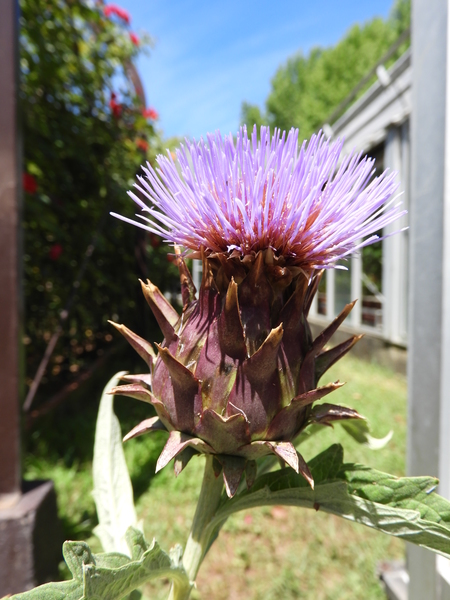
Japanese name: カルドン Scientific name:Cynara cardunculus
[Overview]
A perennial 80–150 cm tall.
The leaves include basal leaves and leaves alternate on the stem; they are deeply pinnately divided, and the underside is densely covered with fine white hairs.
The leaf tips are sharply pointed like spines.
The flower heads are borne at the stem tips, about 10 cm across, consist only of tubular florets, resemble a thistle, and are pale purple.
The tips of the involucral bracts are sharply pointed.
The fruit is an achene.
[Uses]
Like the artichoke, the young buds are eaten.
The stems and taproot can also be eaten.
Oil is obtained from the seeds.
The flower heads, leaves and roots are used medicinally.
[Cultivation]
Propagate from seed or by suckers.
It is hardy to cold, but in regions with heavy frost it needs protection from the cold.
Care is also needed with summer humidity and dryness.
It has a taproot and dislikes being transplanted.
It prefers sunny, well-drained soil.
Rainfall is sufficient unless sunny weather continues and the soil becomes dry.