
Plant Encyclopedia

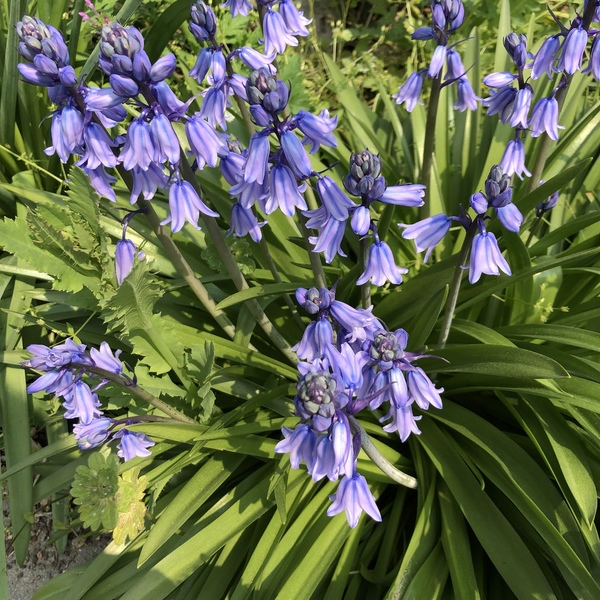
Hyacinthoides (genus)
Japanese name: シラー カンパニュラータ
Scientific name: Hyacinthoides
[Overview]
A perennial with an underground bulb.
The leaves are basal, linear, fleshy, and entire.
The leaves wither by June, and the plant is dormant during summer.
A thick flower stalk emerges from the center of the leaves and bears many flowers in a raceme.
The flowers are bell-shaped with 6 petals, hang downward, and the tips of the tepals curve back.
Flower colors include blue, purple, pink and white.
[History]
The name Scilla campanulata originally refers to Hyacinthoides hispanica (synonym Scilla campanulata), but most of what is sold in Japan as Scilla campanulata is Hyacinthoides ×massartiana, a hybrid of Hyacinthoides hispanica and Hyacinthoides non-scripta, and its form is intermediate between the two.
Hyacinthoides hispanica and Hyacinthoides non-scripta are also available.
Hyacinthoides hispanica is native to the Iberian Peninsula and North Africa.
The flower stalk is thick and erect, and the leaves are wide.
It bears about 15 flowers, which are broadly bell-shaped and slightly open, with the tips of the corolla slightly curved back.
The anthers are blue.
The flowers often face obliquely upward.
The flowers have no fragrance.
Hyacinthoides non-scripta is native to northwestern Spain and Britain.
The flower stalk is slender and arches over at the top, and the leaves are narrow.
The 6–12 flowers hang down on one side of the flower stalk; they are narrowly bell-shaped, with the tips of the corolla strongly curved back.
The anthers are cream-colored.
The flowers are fragrant.
[Cultivation]
Propagate by dividing the bulbs.
It grows well from full sun to partial shade as long as the soil is well drained.
For plants in the ground, it is good to plant them under deciduous trees or similar.
For potted plants, water thoroughly during the growing season when the soil surface dries.
For plants in the ground, rainfall is sufficient.
For potted plants, apply slow-release fertilizer placed on the soil three times: right after sprouting, in early spring, and after flowering.
For plants in the ground, no fertilizer is particularly necessary.
There are no particular pests or diseases.
Details
Translated from our Japanese encyclopedia. If anything differs, the Japanese page is correct.