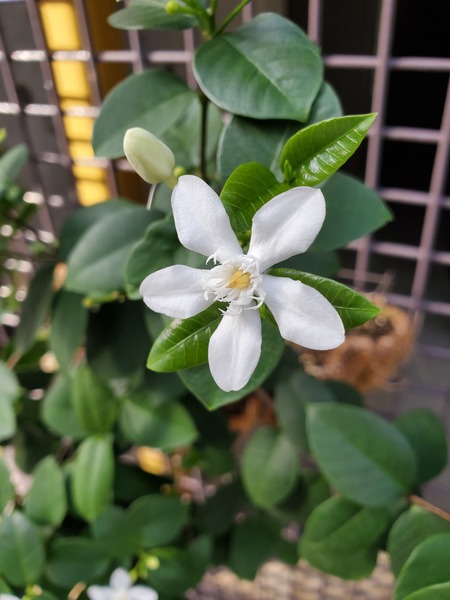
Japanese name: セイロンライティア Scientific name:Wrightia antidysenterica
[Overview]
An evergreen shrub 0.5–2 m tall.
It branches well.
The leaves are simple and opposite, elliptic to ovate, 2.5–6 cm long and 1.5–2.5 cm wide, with entire margins.
Cymes are produced at the branch tips.
The flowers are white, about 2.5–3.5 cm across; the corolla is 5-lobed and opens flat, and the center has a finely divided corona.
The stamens are yellow.
The fruit is a follicle.
[Cultivation]
Propagate by cuttings.
For overwintering, keep it at 10–15 °C or higher.
It prefers sunny, well-drained, fertile soil, but it dislikes strong direct sunlight in summer, so move potted plants to partial shade in midsummer.
In winter, bring it indoors into a sunny place.
Take care not to let it dry out; for potted plants, water thoroughly from spring to autumn when the soil surface dries, and if kept on the dry side in winter, it tolerates temperatures down to about 10 °C.
For plants in the ground, rainfall is sufficient unless sunny weather continues and the soil dries out.
During the growing season, apply liquid fertilizer about twice a month.
There are no particular pests or diseases.