[Overview]
A perennial.
It has a thick rhizome.
The basal leaves are palmately or pinnately divided, with toothed segments and long petioles.
The stem is hardly branched, and the leaves are sparse.
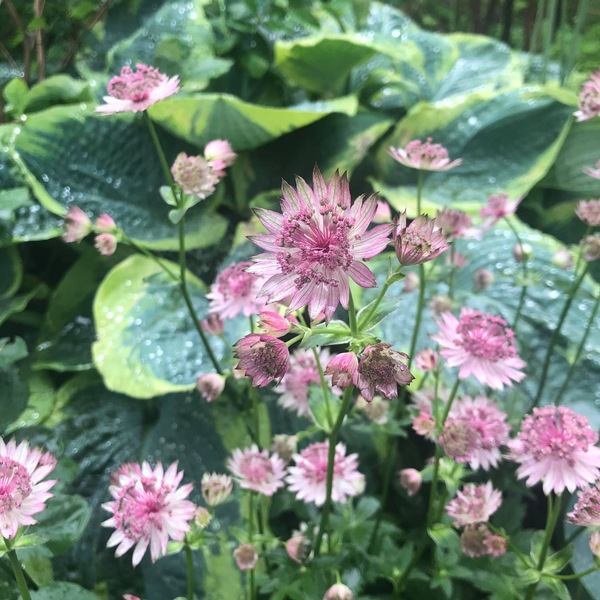
Compound umbels at the tips of long flower stalks bear many small 5-petaled flowers, forming a hemisphere.
The stamens protrude out of the flower.
The inflorescence has colored, leaf-like involucres arranged radially like petals.
The fruit is a flattened mericarp.
[Cultivation]
Propagate from seed or by division.
It dislikes heat, humidity and dryness, and prefers a cool climate.
It prefers moist soil in partial shade with good ventilation.
In warm regions, cover the ground with bark or similar to prevent dryness and a rise in soil temperature.
Water thoroughly when the soil surface begins to dry, and in hot periods water in the cooler morning and evening.
Apply fertilizer in spring and autumn so that none remains in midsummer, or apply slow-release fertilizer in winter.
There are no particular pests or diseases, but larvae of the swallowtail butterfly Papilio machaon, which feed on plants of the carrot family, may infest it.
Poor drainage may also bring root-knot nematodes.