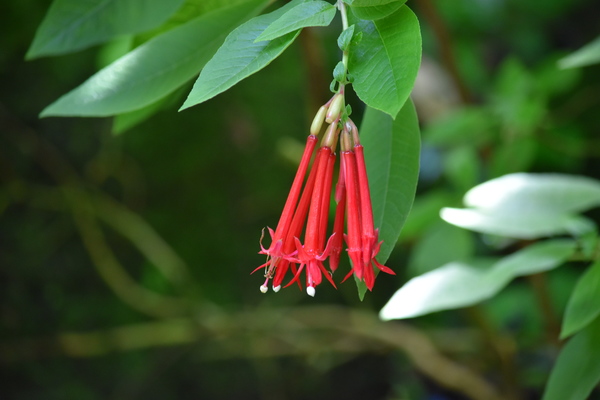
Japanese name: フクシア ボリビアナ プベルレンタ Scientific name:Fuchsia boliviana f. puberulenta
[Overview]
An evergreen shrub 2–6 m tall.
The branches hang down and are covered with soft hairs.
The leaves are simple and mostly opposite.
They are ovate to oblong, 5–20 cm long and 3–15 cm wide, with fine serrations on the margin.
The petiole is 1–7 cm long.
A drooping raceme at the stem tip bears red flowers with a long tubular shape, 3–7 cm long.
The calyx tube is almost as long as the flower and encloses it, and the calyx lobes are triangular, 1–1.5 cm long, and curve back.
Both the calyx tube and calyx are red.
The fruit is a cylindrical berry 1–2.6 cm long and 0.8–1.4 cm wide, ripening to dark purple.
[Cultivation]
Propagate by cuttings.
Keep it at 5°C or above over winter.
It prefers a well-drained, slightly acidic soil.
From autumn to spring, place it in a sunny location; in summer, place it in a cool, airy, partially shaded spot.
In spring and autumn, water thoroughly when the soil surface dries; in winter keep it on the dry side; in summer water only to the extent that the soil does not become waterlogged.
In spring and autumn, place slow-release fertilizer on the soil.
Pests and diseases include gray mold, sooty mold, greenhouse whitefly and spider mites.