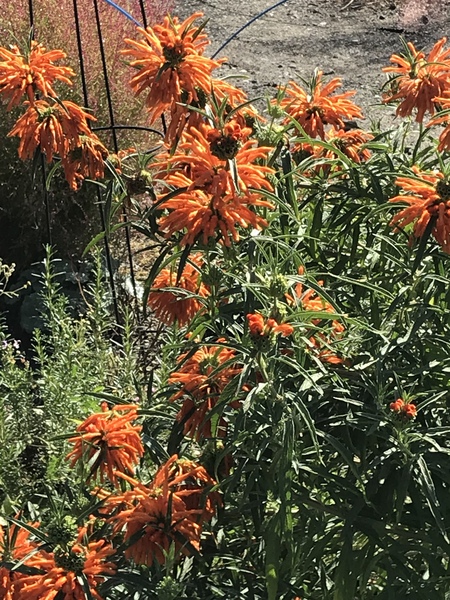
Japanese name: カエンキセワタ(火炎被綿) Scientific name:Leonotis leonurus
[Overview]
A subshrub 1–2 m tall.
It is evergreen in its native habitat, but in Japan the aboveground parts often die back in winter.
The whole plant is covered with many hairs.
The stem branches well in the upper part and is square in cross section.
The leaves are simple and opposite, lanceolate, 5–10 cm long, with blunt teeth on the margins.
Verticillasters at the top of the stem bear many orange to orange-red lipped flowers 7–8 cm long.
The fruit is a schizocarp.
[Cultivation]
Propagate from seed or by cuttings.
It can overwinter outdoors in warm regions without frost.
Even if the aboveground parts die back in winter, it will sprout again the following spring as long as it does not freeze, so protect it from the cold by covering the base of the plant with straw or similar.
It prefers sunny, well-drained soil.
Rainfall is sufficient unless summer brings a long spell of sunny weather and the soil becomes severely dry.
If base fertilizer is applied, no further fertilizing is particularly necessary.
There are no particular pests or diseases.