EVERGREEN

Plant Encyclopedia

Tecoma capensis

Tecoma capensis (Cape honeysuckle, "Himenozenkazura")

Japanese name: ヒメノウゼンカズラ (姫凌霄花)
Scientific name: Tecoma capensis

Tecoma capensis

[Overview]
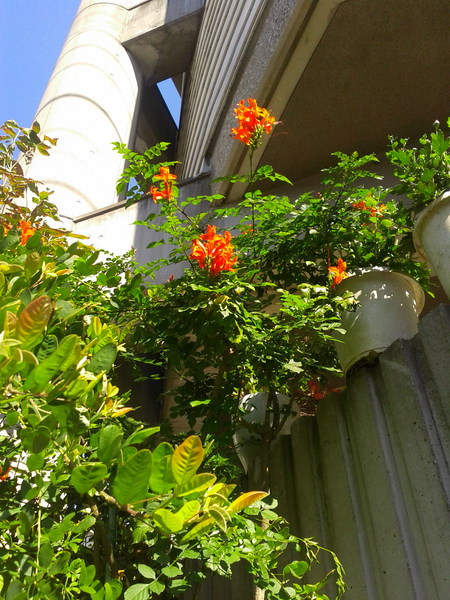
A semi-climbing shrub 2–3 m tall.
It is evergreen, but in Japan it is deciduous except in warm regions.
Leaves are opposite and odd-pinnately compound, 15 cm long, consisting of 5–9 leaflets.
The leaflets are broadly ovate to ovate-orbicular, with serrations.
Dense racemes 10–15 cm long are borne at the branch tips.
The flowers are orange-red, funnel-shaped, 3 cm long and 3.5 cm across, with 5 lobes at the tip arranged in two lips.
The floral tube is slightly curved.
There are 4 stamens, which protrude out of the flower.
It flowers all year round if the temperature is suitable.
The fruit is a linear capsule 3–5 cm long.

[Cultivation]
Propagate by cuttings.
It prefers sunny, well-drained soil.

Details

Names
English: Cape honeysuckle
Japanese: ヒメノウゼンカズラ(姫凌霄花)
Life form
Shrub
Evergreen / deciduous
Evergreen, Deciduous
Leaf type
Broadleaf
Habit
Terrestrial
Planting (or sowing) season
April, May, June
Flowering season
July, August, September
Distribution or origin
South Africa
Growth form
Branching
Height
2000–3000 mm
Leaf shape
Odd-pinnate compound leaf
Leaf arrangement
Opposite
Leaf margin
Serrate
Inflorescence
Raceme
Flower color
Red, Orange
Flower diameter
35
Inflorescence length
100–150
Leaf color
Green
Availability of seeds and plants
Low
Form sold
Seedlings
Propagation
Cuttings
Sun exposure
Full sun
Water needs
Moderate
Soil needs
Required
Suitable uses
Wall greening, Parks and gardens
Japan Flower Trade Code
20461

Translated from our Japanese encyclopedia. If anything differs, the Japanese page is correct.

Sponsored