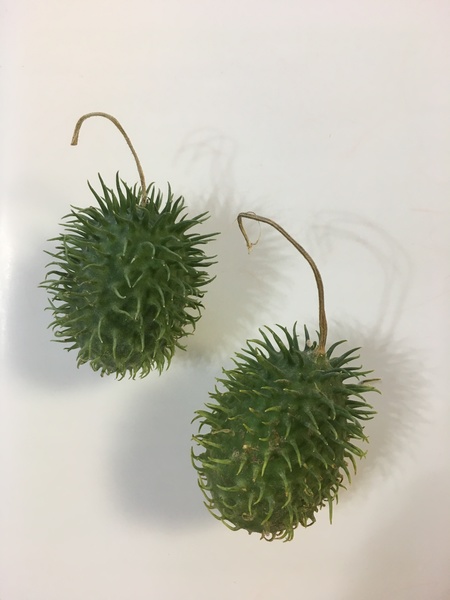
Japanese name: ククミス アングリア Scientific name:Cucumis anguria
[Overview]
A climbing annual.
The stems grow up to about 3 m, creeping along the ground or climbing by twining around other objects with tendrils.
The stems and leaves are hairy and rough.
The leaves are alternate, palmately lobed, and toothed.
There are male and female flowers; male flowers grow in clusters of several, and female flowers are usually solitary.
The flowers are bell-shaped, 5-lobed and yellow.
The fruit is elliptic, 4–5 cm long and 3–4 cm wide, with a surface covered in spines.
The fruit turns yellow when ripe.
[Uses]
In its native range, the fruit and young leaves are eaten.
It is also used as a folk medicine.
In Japan, the fruit is used as an ornament.
[Cultivation]
Propagate from seed.
The optimum growing temperature is 21–28°C.
It can be harvested 40–80 days after sowing.
It prefers sunny, well-drained, moisture-retentive, fertile soil.
Rainfall is sufficient for watering.
No fertilizer is particularly needed if basal fertilizer is applied.
Aphids can occur.