EVERGREEN

Plant Encyclopedia

Myosotis

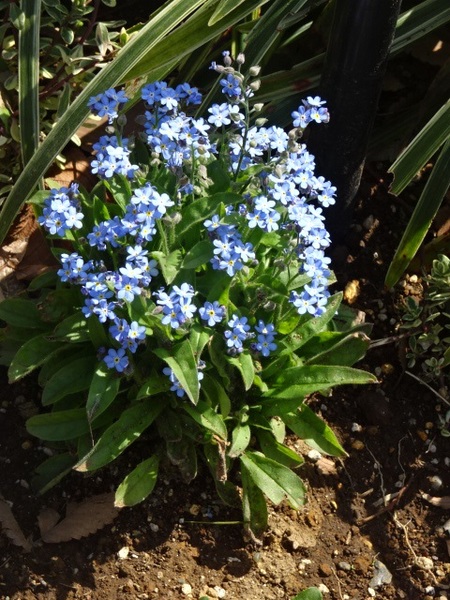
Myosotis (genus, forget-me-nots, "Wasurenagusa")

Japanese name: ワスレナグサ (勿忘草、忘れな草)
Scientific name: Myosotis

Myosotis

[Overview]
An annual or perennial.
The whole plant is hairy.
There are basal leaves and stem leaves, both simple and with entire margins.
The leaves on the stem are alternate.
The basal leaves and the leaves on the lower part of the stem have petioles.
The flowers are borne in scorpioid cymes or solitary, and the corolla is 5-lobed.
The fruit is a schizocarp.

[Cultivation]
Propagate from seed.
It also spreads readily from self-sown seed.
It dislikes having large plants transplanted, so sow directly where it is to grow, or sow in plastic pots and plant out the young seedlings.
It prefers a sunny, airy place with soil that is well drained, moisture-retentive and well aerated.
Take care not to let it dry out; water thoroughly when the soil surface dries.
If base fertilizer is applied, no further fertilizing is particularly necessary.
Gray mold can occur.

Details

Names
English: forget-me-nots, scorpion grasses
Japanese: ワスレナグサ(勿忘草、忘れな草)、ミオソティス
Life form
Annual, Perennial
Habit
Terrestrial
Planting (or sowing) season
February, March, September, October
Flowering season
March, April, May, June
Distribution or origin
Temperate regions of the world
Leaf shape
Simple leaf (unlobed)
Leaf arrangement
Alternate, Basal
Leaf margin
Entire
Inflorescence
Solitary, Scorpioid cyme
Flower color
Blue, Purple, Pink, White
Leaf color
Green
Availability of seeds and plants
Low
Form sold
Seeds, Seedlings
Propagation
Seed
Sun exposure
Full sun
Water needs
Moderate
Soil needs
Required
Tolerance
Heat intolerance
Suitable uses
Potted plant, Flower bed, Cut flowers, Container
Diseases
Gray mold
Japan Flower Trade Code
14439

Translated from our Japanese encyclopedia. If anything differs, the Japanese page is correct.

Sponsored