
Plant Encyclopedia

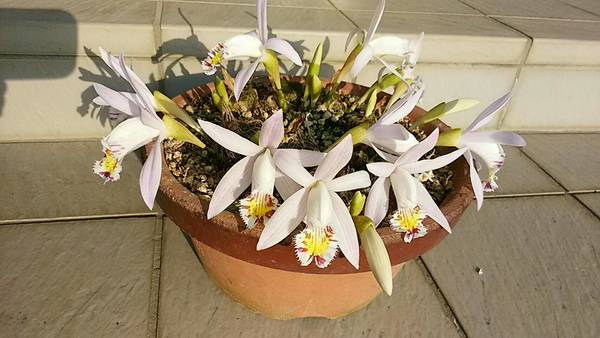
Pleione bulbocodioides ("Tairintokiso")
Japanese name: タイリントキソウ (大輪朱鷺草)
Scientific name: Pleione bulbocodioides
[Overview]
A perennial about 25 cm tall.
In its native range it is found at elevations of 900–3,600 m, in humus-rich soil and on rocky ground in evergreen broadleaf forests.
It has conical pseudobulbs 1–2.5 cm tall and 1–2 cm across, often tinged with purple, and each bears one leaf from its tip.
The pseudobulb is renewed in autumn, and the renewed young bulb overwinters.
Bulbils form at the tip of the stem.
The leaf is elliptic to lanceolate, 10–25 cm long and 2–5.8 cm wide, pointed at the tip, with conspicuous parallel veins.
The leaf margin is entire.
The leaf withers around the time the pseudobulb is renewed.
A raceme emerges at the tip of a flower stalk 7–20 cm tall that grows from the base of the pseudobulb, bearing 1–2 flowers.
The flowers are 5–12 cm across and pale reddish purple to pink; the lip is usually milky white with light brown markings.
The edge of the lip is finely divided into threadlike segments.
The fruit is a capsule.
[Cultivation]
Propagate by dividing the bulbs or from bulbils.
To overwinter, keep it at 5°C or higher.
It prefers partial shade and well-ventilated, well-drained soil.
It may also be planted in sphagnum moss alone.
From sprouting through the period when leaves are present, water thoroughly when the surface of the potting medium dries; when the leaves begin to turn yellow, gradually reduce watering, and during dormancy water about 1–2 times a month.
During the growing season, give diluted liquid fertilizer about once every 2 weeks.
Pests include spider mites and slugs.
Details
Translated from our Japanese encyclopedia. If anything differs, the Japanese page is correct.